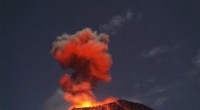
* Formation: Cinder cones are formed by relatively small, short-lived eruptions of basaltic lava. The lava is ejected as blobs of molten rock called "cinders," which solidify and pile up around the vent, creating the cone shape.
* Location: They can occur in a variety of locations:
* Independent: Cinder cones can be found independently, not associated with any larger volcano.
* Within calderas: They can form within the collapsed craters of larger volcanoes.
* Flank eruptions: Occasionally, cinder cones can form on the flanks (sides) of larger volcanoes, but this is not the norm.
* Large Volcanoes: Large volcanoes, like shield volcanoes or stratovolcanoes, typically have a complex history of eruptions and are often formed by a series of eruptions over long periods. Their size and structure are not conducive to the formation of cinder cones at their edges.
In summary: While cinder cones can form on the flanks of large volcanoes in some cases, they are not typically found at their edges. They are more commonly found as independent features or within the craters of larger volcanoes.