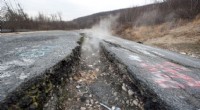
1. Caves and Caverns: When rainwater, slightly acidic due to dissolved CO2, reacts with limestone, it dissolves the rock. This process, called karst topography, forms caves and caverns over time.
2. Stalactites and Stalagmites: Inside caves, the dissolved limestone can precipitate out again, forming these iconic structures. Stalactites hang from the ceiling, while stalagmites grow upwards from the floor.
3. Sinkholes: As limestone dissolves, the ground above can collapse, creating sinkholes.
4. Travertine: When dissolved limestone precipitates out of hot springs, it can form a porous, layered rock called travertine. This is often used in building materials.
5. Tufa: Similar to travertine, tufa forms when dissolved limestone precipitates out of cold water, often near waterfalls or springs.
6. Limestone deposits: In some cases, dissolved limestone can re-precipitate out of solution, forming new limestone deposits.
7. Limestone concretions: These are small, rounded deposits of limestone that form within sedimentary rocks.
8. Calcite crystals: Dissolved limestone can also crystallize into calcite crystals, which are often found in caves or as part of other geological formations.
The specific form that dissolved limestone will take depends on factors like the water chemistry, temperature, pressure, and the presence of other minerals.