Here's why:
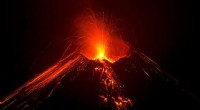
* Basaltic lava: This type of lava is very fluid and has low viscosity. It flows easily and spreads out over large areas, forming thin layers.
* Non-explosive eruption: The eruption is gentle and does not involve significant amounts of ash or pyroclastic material.
* Accumulation of layers: As the lava flows out, it cools and solidifies, creating layers upon layers. These layers build up over time, forming a broad, gently sloping cone.
Characteristics of Shield Volcanoes:
* Broad, gently sloping cones: They have a wide base and rise gradually to a summit.
* Large in size: They are often the largest volcanoes on Earth.
* Fluid lava flows: The eruptions produce large volumes of fluid lava that travel long distances.
* Examples: Mauna Loa and Kilauea in Hawaii are classic examples of shield volcanoes.
Let me know if you have any other volcano-related questions! 🌋