Here's how gravitational forces influence their geology:
Io:
* Tidal Heating: Io experiences the strongest tidal forces due to its proximity to Jupiter and its elliptical orbit. This creates immense internal friction, generating a tremendous amount of heat that melts the moon's interior.
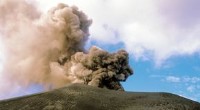
* Volcanism: The internal heat drives intense volcanic activity, making Io the most volcanically active body in the solar system. Its surface is dotted with volcanoes, lava flows, and sulfurous plumes.
* Lack of Craters: The continuous volcanic activity resurfaces Io, effectively erasing any impact craters.
Europa:
* Tidal Heating: Europa also experiences significant tidal heating, although less intense than Io. This keeps its subsurface ocean in a liquid state.
* Ice Shell: The surface of Europa is covered by a thick layer of ice, likely with an underlying liquid water ocean.
* Cracks and Ridges: Tidal forces create cracks and ridges on the surface, indicating tectonic activity driven by the ocean below.
* Possible Hydrothermal Vents: Interactions between the ocean and the rocky mantle could create hydrothermal vents, similar to those found on Earth.
Ganymede:
* Tidal Heating: Ganymede experiences weaker tidal heating than Io or Europa, but it still plays a role in its geology.
* Largest Moon: Being the largest moon in the solar system, Ganymede has its own internal heat generated by radioactive decay.
* Differentiation: This internal heat led to differentiation, with a metallic core, a rocky mantle, and an icy surface.
* Magnetic Field: Ganymede is the only moon with its own magnetic field, likely generated by the movement of its metallic core.
* Cratered Terrain: The older parts of Ganymede's surface are heavily cratered, while younger regions exhibit tectonic features like grooves and ridges.
Callisto:
* Weak Tidal Heating: Callisto experiences the weakest tidal heating among the four moons.
* Heavily Cratered: Its surface is densely cratered, indicating a very old and inactive geological history.
* Ancient Impact Basins: Callisto is home to some of the largest impact basins in the solar system, formed early in its history.
* Lack of Internal Activity: Callisto shows little evidence of internal activity, suggesting it has remained relatively unchanged since its formation.
In summary:
Gravitational forces play a fundamental role in the geology of Jupiter's four major moons, affecting their internal heat, surface features, and overall geological activity. While Io experiences the most extreme effects, all four moons exhibit unique geological characteristics shaped by Jupiter's gravitational pull.