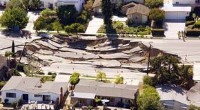
* Earthquakes: As the plates grind against each other, the friction creates stress that builds up over time. Eventually, this stress is released in sudden, violent bursts, causing earthquakes.
Here's why other options are less likely:
* Volcanoes: Volcanic activity is more common at convergent boundaries where plates collide, and at divergent boundaries where plates pull apart.
* Mountain ranges: Mountain ranges primarily form at convergent boundaries where plates collide and push up the Earth's crust.
* Ocean trenches: Ocean trenches are also formed at convergent boundaries, typically where an oceanic plate subducts beneath another plate.
Examples of transform fault boundaries and their associated earthquakes:
* San Andreas Fault (California, USA): This is a well-known example where the Pacific Plate is sliding past the North American Plate.
* The Alpine Fault (New Zealand): This fault separates the Pacific Plate from the Australian Plate.
Let me know if you have any other questions about tectonic plates!