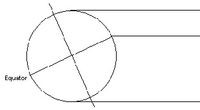
* Parallel to the Equator: All lines of latitude run parallel to the equator, which is the imaginary line that divides the Earth into the Northern and Southern Hemispheres.
* Measure of Distance from the Equator: Latitude lines are used to measure the distance of a location north or south of the equator. The equator is designated as 0° latitude, and the lines extend to 90° North (North Pole) and 90° South (South Pole).
* Constant Angle to the Sun: Every point on the same line of latitude experiences the same angle of the sun's rays at any given time of the year.
* Different Lengths: Latitude lines are not all the same length. The equator is the longest latitude line, and the lines get shorter as you move towards the poles.
* Important for Navigation: Latitude lines, along with longitude lines, are crucial for navigation, as they allow us to pinpoint the exact location of a place on the Earth.
Think of latitude lines as a way to slice the Earth like an orange, with each slice representing a different latitude.