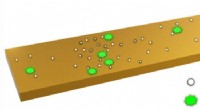
* Pumice is porous: Pumice is a volcanic rock with many air pockets. This makes it very lightweight, but the density varies depending on the size and amount of these air pockets.
* Density is a property of the material, not the mass: Density is defined as mass per unit volume (density = mass/volume). You only provided the mass, not the volume.
To find the density of your pumice rock, you need to do the following:
1. Measure the volume: You can do this by water displacement. Fill a graduated cylinder with water, note the initial level. Carefully drop the pumice rock into the cylinder, and note the new water level. The difference between the two levels is the volume of the rock.
2. Calculate the density: Divide the mass (1.3 kg) by the volume you just measured.
Example:
* If the volume of the pumice rock is 0.5 liters (0.5 dm³), then:
* Density = 1.3 kg / 0.5 dm³ = 2.6 kg/dm³
Keep in mind:
* The density of pumice rock typically ranges from 0.2 to 0.9 g/cm³ (or 0.2 to 0.9 kg/dm³).
* Your calculated density will be within this range but will vary depending on the specific pumice rock sample.