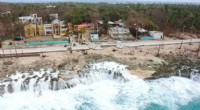
Volcanic Rocks:
* Origin: Formed from molten rock (magma) that erupts from the volcano.
* Formation:
* Extrusive rocks: Form when lava cools and solidifies on the Earth's surface. They are often fine-grained, with rapid cooling.
* Intrusive rocks: Form when magma cools and solidifies underground. They are typically coarse-grained, due to slower cooling.
* Characteristics:
* Darker colors: Due to high iron and magnesium content.
* Porous: Often have air bubbles trapped during cooling.
* Crystalline: Minerals are visible to the naked eye.
* Examples: Basalt, rhyolite, andesite.
Beach Rocks:
* Origin: Erosion and transportation of rocks from various sources.
* Formation:
* Weathering: Rocks break down due to exposure to elements.
* Transportation: Waves and currents carry rock fragments to the beach.
* Deposition: Rocks settle and accumulate on the beach.
* Characteristics:
* Variety of rock types: Can be igneous, sedimentary, or metamorphic.
* Rounded and smooth: Due to abrasion by waves and sand.
* Variable color: Depending on the original rock types.
* Examples: Pebbles, cobbles, sand, shells.
In summary, the key differences lie in:
* Origin: Volcanic rocks form from magma, while beach rocks are eroded and transported from diverse sources.
* Formation: Volcanic rocks form from cooling magma, while beach rocks are formed by weathering and deposition.
* Composition: Volcanic rocks are primarily igneous, while beach rocks can be of various types.
* Appearance: Volcanic rocks are often darker, porous, and crystalline, while beach rocks are typically rounded, smooth, and varied in color.