1. Paleomagnetism:
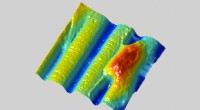
* Magnetic striping: The Earth's magnetic field flips its polarity over time. This leaves a record in the rocks as they cool and solidify. Rocks on either side of the mid-ocean ridge exhibit a symmetrical pattern of magnetic stripes, with older stripes further away from the ridge. This pattern demonstrates that new oceanic crust is created at the ridge, pushing older crust outwards.
* Radiometric dating: This technique uses the decay of radioactive isotopes to determine the age of rocks. By dating rocks at various distances from the ridge, scientists confirmed that the further away the rock, the older it was.
2. Sediment thickness:
* Sediment accumulation: The amount of sediment accumulating on the ocean floor increases with time. Rocks further away from the ridge are buried under thicker sediment layers, indicating their older age.
3. Ocean drilling:
* Deep sea drilling programs: Drilling into the ocean floor provided samples of rocks at various depths and distances from the ridge. The analysis of these samples confirmed the age progression away from the ridge.
4. Plate tectonic theory:
* Seafloor spreading: The theory of plate tectonics postulates that new oceanic crust is created at mid-ocean ridges and pushed away from the ridge. This model explains the observed pattern of older rocks farther away from the ridge.
In summary:
The discovery of the age progression of oceanic crust away from the mid-ocean ridge was a crucial piece of evidence supporting the theory of plate tectonics. It demonstrated that the Earth's surface is dynamic and constantly changing, with new crust being created at mid-ocean ridges and older crust being pushed away.