1. Formation of Pangaea:
* The Devonian saw the continued collision of continents, culminating in the formation of the supercontinent Pangaea. This process began in the Silurian and continued throughout the Devonian. The collision of Laurentia (North America) and Baltica (Europe) formed a large landmass called Euramerica, while Gondwana (South America, Africa, Antarctica, Australia, and India) continued to drift northward.
2. Caledonian and Acadian Orogenies:
* The collision of continents caused extensive mountain building, leading to the Caledonian Orogeny in northern Europe and the Acadian Orogeny in eastern North America. These events resulted in the uplift of large mountain ranges, volcanic activity, and metamorphic rock formation.
3. Volcanic Activity:
* Devonian volcanic activity was widespread, particularly in areas associated with the collision of continents. Extensive volcanic flows and ash falls occurred, contributing to the formation of igneous rocks and influencing the climate.
4. Development of Reefs and Shallow Seas:
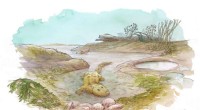
* The Devonian saw the flourishing of reef systems, which were dominated by corals, stromatoporoids, and crinoids. These reefs formed extensive carbonate platforms in shallow seas, creating diverse habitats for marine life.
5. Formation of the Old Red Sandstone:
* The Devonian was characterized by the deposition of thick layers of red sandstone, often associated with fluvial environments. These sediments, collectively known as the Old Red Sandstone, are found in areas like Scotland, Wales, and the eastern United States.
6. Climate Change:
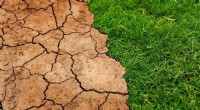
* The Devonian climate was generally warm and humid, but experienced significant fluctuations. The early Devonian was relatively warm and wet, while the middle to late Devonian saw a cooling trend and the onset of drier conditions. This shift may have been influenced by changes in atmospheric composition and volcanic activity.
7. Extinction Events:
* The Devonian ended with the Late Devonian extinction event, one of the "Big Five" mass extinctions. While its exact cause is still debated, the event likely involved a combination of factors such as climate change, ocean anoxia, and volcanic eruptions. This event led to the extinction of approximately 75% of all species.
In summary, the Devonian was a period of significant geologic activity, marked by the formation of Pangaea, mountain building, volcanic eruptions, the development of extensive reefs, climate change, and a major extinction event. These events shaped the Earth's geography and played a crucial role in the evolution of life.