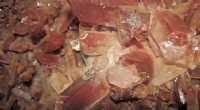
* Recrystallization: The heat causes the mineral grains within the sandstone to dissolve and recrystallize. This creates larger, interlocking crystals.
* Change in Texture: The pressure compresses the sandstone, causing the grains to become more tightly packed and the rock to become more dense.
* Formation of New Minerals: The extreme conditions can cause the formation of new minerals, often depending on the original composition of the sandstone.
The specific metamorphic rock that forms depends on the original composition of the sandstone and the intensity of the heat and pressure. Here are some possibilities:
* Quartzite: If the sandstone is primarily composed of quartz, it can transform into quartzite. This is a very hard and durable rock with a glassy texture.
* Marble: If the sandstone contains a significant amount of calcite, it can change into marble. This is a beautiful, often colorful rock with a crystalline texture.
* Other Metamorphic Rocks: Other metamorphic rocks like gneiss, schist, or slate can form depending on the specific conditions and the original composition of the sandstone.
The transformation of sandstone into metamorphic rock is a fascinating process that highlights the immense power of geological forces.