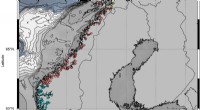
* Mid-ocean ridges: These are underwater mountain ranges formed as magma rises from the mantle and erupts, solidifying into new oceanic crust.
* Rift valleys: On land, divergent boundaries can cause the crust to stretch and thin, leading to the formation of valleys that can be filled with lakes. The East African Rift Valley is a good example.
* Volcanoes: The magma that rises from the mantle often erupts through the surface, forming volcanoes. The volcanoes on mid-ocean ridges are generally less explosive than those found at convergent boundaries.
* Seafloor spreading: As plates move apart, new crust is created at the divergent boundary, pushing the existing crust further away. This process is known as seafloor spreading.
* Earthquakes: The movement of tectonic plates along divergent boundaries can cause earthquakes, although they are generally less powerful than those found at convergent boundaries.
In summary, divergent boundaries are characterized by the creation of new crust, the formation of rift valleys, and the presence of volcanoes and earthquakes.