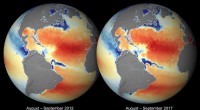
The Earth is nearly spherical in shape, although it has a slight equatorial bulge and is slightly flattened at the poles. its mean diameter is approximately 12,742 kilometers (7,918 miles), and its circumference is about 40,075 kilometers (24,901 miles) at the equator.
Shape of the Earth:
- Oblate Spheroid: The Earth's shape is best approximated by a slightly oblate spheroid, which is a three - dimensional figure resembling a slightly flattened sphere.
- Equatorial Bulge: Due to the Earth's rotation, the centrifugal force causes a slight bulging at the equator. This equatorial bulge is about 42 kilometers (26 miles) more significant than the Earths radius at the poles.
- Polar Flattening: The Earth is also slightly flattened at the poles. This is because gravitational forces are slightly weaker at the equator compared to the poles, resulting in a slight flattening effect.
- Geoid: The Earth's actual physical surface, including mountains, valleys, and ocean depths, is known as the geoid. It deviates slightly from the ideal shape of an oblate spheroid due to the varying density and mass distribution within the Earth.
The Earth's size and shape are crucial factors in various scientific fields and have significant implications for our understanding of the planet's dynamics, climate, and overall behavior.