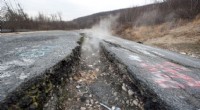
1. Frost wedging: When water seeps into cracks and crevices in rocks and then freezes, it expands in volume by about 9%. This expansion creates a force that pries open the cracks, gradually widening and deepening them. As temperatures fluctuate, repeated freezing and melting cycles cause the cracks to grow, eventually breaking the rock apart.
2. Ice abrasion: When water freezes on rock surfaces and forms ice sheets or glaciers, it can scour and abrade the underlying rock as it moves. The ice acts like a giant sandpaper, wearing down and smoothing out rough edges and surfaces. This process, known as glacial abrasion, is particularly effective in mountainous regions with glaciers and ice sheets.
3. Frost shattering: In some cases, when water freezes rapidly inside rocks, it can create internal stresses and pressures that exceed the rock's strength. This can cause the rock to break apart into smaller pieces or fragments, a phenomenon known as frost shattering.
4. Hydrolysis: Freezing and melting water can also contribute to chemical weathering through a process called hydrolysis. When water molecules dissociate into hydrogen and oxygen ions (H+ and OH-), they can react with minerals in rocks, breaking them down and transforming them into new minerals. This chemical alteration weakens the rock and makes it more susceptible to further weathering.
The effectiveness of freeze-thaw weathering depends on several factors, including the porosity and permeability of the rock, the frequency of temperature fluctuations, and the availability of water. It is most pronounced in areas with abundant moisture and frequent freeze-thaw cycles, such as mountainous regions or cold climates.