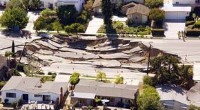
Liquefaction: Loose soils, such as sandy or water-saturated soils, are more susceptible to liquefaction during earthquakes. Liquefaction occurs when the solid soil particles lose their cohesion and behave like a liquid due to intense shaking. This can cause the ground to become unstable and lose its bearing capacity, leading to significant structural damage to buildings.
Ground Amplification: Loose soil and rock can amplify the intensity of seismic waves, causing stronger ground shaking. This phenomenon, known as ground amplification, occurs because loose materials tend to vibrate more vigorously and resonate with the earthquake's frequencies. As a result, structures built on loose soil experience greater seismic forces and are more prone to damage.
Differential Settlement: Loose soil can undergo significant settlement or sinking after an earthquake. This is because the shaking causes the soil particles to shift and compact, resulting in uneven ground movement. Differential settlement can cause buildings to tilt, crack, or even collapse, especially if they have rigid foundations that cannot withstand the uneven movement.
Structural Resonance: Buildings built on loose soil are more susceptible to structural resonance, which occurs when the natural frequency of the building matches the frequency of the seismic waves. Resonance can amplify the shaking and cause severe damage to the building's structure, potentially leading to partial or complete collapse.
Loss of Lateral Support: Loose soil and rock can provide less lateral support to buildings during earthquakes. This is particularly concerning for taller structures, which rely on adequate lateral support to resist the horizontal forces generated by seismic shaking. The lack of lateral support in loose soil can lead to excessive swaying, cracking, and ultimately, structural failure.
Given these factors, buildings constructed on loose soil and rock are considered more vulnerable to earthquake damage and are often subjected to stricter building codes and engineering requirements in earthquake-prone regions.