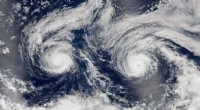
1. Blocking and Splitting of Jet Streams: The Tibetan Plateau acts as a barrier to the prevailing westerly winds, causing them to split into two branches. One branch flows to the north of the plateau, while the other flows to the south. This splitting of the jet streams can lead to the formation of distinct weather patterns on either side of the plateau.
2. Formation of the Jet Streams: The Tibetan Plateau is thought to have played a role in the formation of the jet streams themselves. The uplift of the plateau created a large-scale temperature gradient between the warm tropics and the cold polar regions, which in turn led to the development of strong winds at high altitudes. These winds are what we now know as the jet streams.
3. Changes in Precipitation Patterns: The uplift of the Tibetan Plateau has also influenced precipitation patterns in the region. The plateau acts as a barrier to moisture-carrying air masses from the Indian Ocean, causing them to condense and release their moisture on the windward side of the plateau. This has resulted in the formation of rainforests and lush vegetation on the southern slopes of the Himalayas.
4. Influence on Monsoons: The Tibetan Plateau also influences the Asian monsoon system. The uplift of the plateau has enhanced the monsoon circulation by increasing the temperature contrast between the Indian Ocean and the Asian landmass. This has led to stronger monsoons and increased rainfall in many parts of Asia.
5. Global Teleconnections: The changes in the westerly circulation caused by the Tibetan uplift can have global teleconnections, affecting weather patterns in distant parts of the world. For example, the Tibetan Plateau has been linked to changes in the North Atlantic Oscillation (NAO) and the Pacific Decadal Oscillation (PDO), which are important climate patterns that influence weather in Europe, North America, and the Pacific Ocean.
Overall, the Tibetan uplift has played a critical role in shaping the present-day structure and dynamics of the westerly circulation and has had a profound impact on regional and global climate patterns.