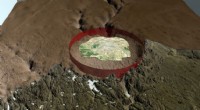
In the world's oldest diamond mines, hidden beneath the sun-baked plains of South Africa, scientists discovered a hidden treasure trove of information. These ancient diamonds, formed over 3 billion years ago, preserved tiny mineral inclusions that hold clues to the processes occurring deep within the Earth.
The research, published in the prestigious journal Nature, unveils the significance of diamonds in stabilizing the roots of continents, which are called cratons. Cratons are ancient and stable parts of the continental crust that have survived billions of years of geological upheavals. They act as pillars, anchoring the continents against the dynamic forces that constantly reshape Earth's surface.
Diamonds form under immense pressure and temperature deep within the Earth. The study revealed that the presence of diamonds within cratons helps strengthen the roots of the continents, preventing them from breaking apart and destabilizing the planet's surface. This stability is essential for the formation and preservation of habitable environments, providing the necessary conditions for life to thrive.
When scientists examined the mineral inclusions within the diamonds, they found evidence of water circulating deep beneath the Earth's surface. This water acts as a lubricant, reducing friction between cratonic blocks and allowing them to move more freely without causing continental breakup.
Furthermore, the team suggests that the diamonds help insulate the continental roots from the extreme heat generated in Earth's interior. This insulation prevents excessive melting of the rocks, protecting the structural integrity of the cratons and the stability of the continents above.
The significance of these findings goes beyond our understanding of Earth's geology. The stabilization of continents has had profound implications for the planet's habitability. Cratons provide stable platforms for the formation of sedimentary basins, where organic material accumulates and converts into fossil fuels, essential resources for human societies.
Moreover, the geological stability created by diamonds has enabled the evolution of complex ecosystems over billions of years. Without stable continents, life would have faced constant upheaval and disruption, hindering the development of complex organisms.
This research adds a fascinating chapter to the story of Earth's geological evolution, highlighting the interconnectedness of Earth's processes and the profound impact of seemingly insignificant elements like diamonds on our planet's habitability. It reminds us that the wonders of Earth extend far beyond what meets the eye, hidden deep beneath the surface where precious gems can hold the keys to unlocking the secrets of our planet's past and present.