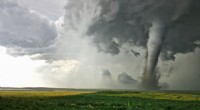
However, here's how mountains can affect tornadoes:
1. Deflected Airflow: Mountain ranges can disrupt and redirect the airflow that supports tornado formation. As air rises over a mountain barrier, it cools, becomes less dense, and tends to flow over or around the mountains rather than converging near the surface, which is necessary for tornado formation.
2. Barrier Effect: Mountains can act as physical barriers that impede the movement of mesocyclones (rotating air columns that can spawn tornadoes). When strong winds associated with a mesocyclone encounter a mountain range, their rotation may be disrupted or weakened, reducing the chances of tornado development.
3. Disruption of Updrafts: Mountains can interfere with the development of strong updraft currents, which are essential for the formation of supercell thunderstorms. Supercells are particularly conducive to generating tornadoes. If mountains disrupt the upward motion of air needed for supercell formation, the probability of tornado occurrence decreases.
4. Local Variations: The terrain near mountain ranges can create localized effects on tornado patterns. Valleys and passes between mountains can sometimes channel winds, making tornadoes more likely to occur in these areas compared to the surrounding higher terrain.
So, while mountains can influence tornado behavior and reduce the frequency of tornadoes in some regions, they don't entirely prevent them. Tornadoes can still occur in mountainous areas, and specific local factors may determine where they are most likely to form and impact communities.