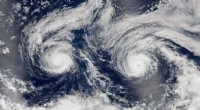
1. Stronger Atmospheric Circulation in the Northern Hemisphere: The Earth's rotation creates a stronger Coriolis effect (a deflecting force) in the Northern Hemisphere than in the Southern Hemisphere. This stronger Coriolis effect drives more vigorous atmospheric circulation patterns in the Northern Hemisphere, leading to larger-scale weather systems and greater amounts of precipitation.
2. North Atlantic and North Pacific Gyres: The Earth's major ocean currents form large gyres (circular patterns) that transport water over vast distances. In the Northern Hemisphere, the North Atlantic Gyre and the North Pacific Gyre rotate clockwise. The western sides of these gyres (the Gulf Stream in the North Atlantic and the Kuroshio Current in the North Pacific) carry warm, moist air from the equatorial regions to high latitudes. This warm, moist air then condenses and precipitates over the continents, contributing to higher precipitation in the Northern Hemisphere.
3. Position of Landmasses: The Northern Hemisphere has more landmasses compared to the Southern Hemisphere. Landmasses heat up and cool down more rapidly than oceans, creating greater temperature contrasts. These contrasts drive atmospheric circulation patterns, including the formation of rain-producing weather systems. As a result, the Northern Hemisphere experiences more frequent and intense precipitation events than the Southern Hemisphere.
While global ocean currents and geographic factors influence precipitation patterns, many other factors contribute to the differences in precipitation between the Northern and Southern Hemispheres. These include atmospheric circulation patterns, prevailing wind directions, sea surface temperatures, altitude, and global temperature variations.