Credit: CC0 Public Domain
Music is an art, but it is also a science involving vibrating reeds and strings, sound waves and resonances. The study of acoustics can help scientists produce beautiful music even with musical instruments fashioned with high-tech methods, such as 3-D printing.
Xiaoyu Niu, from the University of Chinese Academy Sciences, and other researchers studied the sound quality of a 3-D-printed ukulele and compared it to a standard wooden instrument. Niu will present the group's results in a talk, "A Comparison on Sound Quality of PLA 3-D Printing Ukulele and Single Board Wooden Ukulele," at the 178th Meeting of the Acoustical Society of America, which will be held Dec. 2-6, at the Hotel del Coronado in San Diego. Niu's talk is part of a session on "General Topics in Musical Acoustics," to be held beginning at 9:00 a.m. on Thursday, Dec. 5.
The ukulele studied by Niu's group was created with a 3-D printer using a type of plastic known as polylactic acid, or PLA. This substance has become quite popular for producing 3-D-printed objects, since the printing can be done at low temperatures.
Niu found under the same plucking force, the wooden ukulele was louder than the 3-D-printed one. The investigators also found the timbre of the two instruments was different. The wooden instrument exhibited more high-frequency vibrations than the 3-D-printed ukulele.
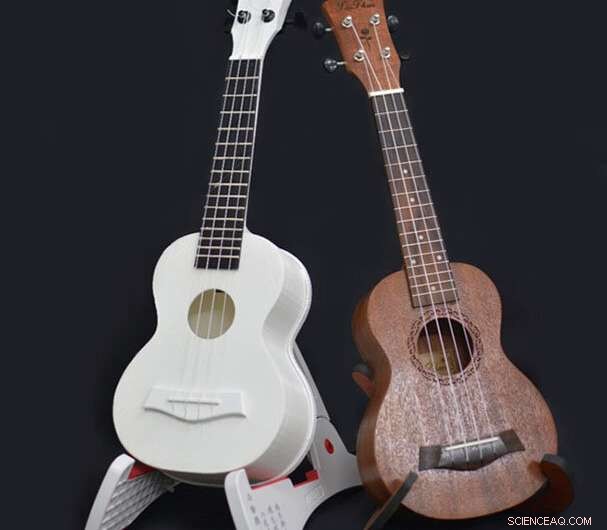
Comparison of a 3D-printed ukulele (left) and a standard wooden instrument (right) Credit: Xiaoyu Niu
"We found that the A-weighted sound pressure of the 3-D-printed instrument was less than that of the wooden one," Niu said. A-weighting is used to account for the relative loudness of low frequency sounds perceived by the human ear.
To explain these differences, the investigators carried out computer calculations using a software package known as COMSOL. They first modeled the ukulele shape mathematically. Using formulas for sound resonance and acoustics, they were able to explain the differences between a standard wooden ukulele and the new high-tech 3-D-printed version. Niu and co-workers plan to continue their work to further improve this mathematical model.