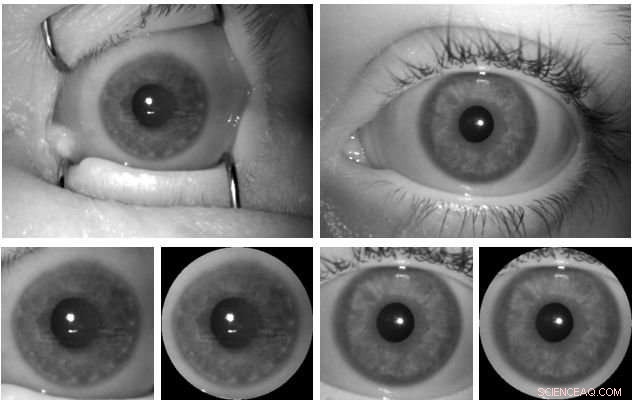
Example iris images obtained from a dead (left) and a live subject (right): original images (top row) and their cropped and cropped masked versions (bottom row). Credit: arXiv:1807.04058 [cs.CV]
A Warsaw, Poland-based team has explored cadaver iris detection, in order to tell a dead iris from a live one. Their paper "Presentation Attack Detection for Cadaver Iris" is on arXiv.
Author affiliations include the Warsaw University of Technology, a biometrics lab and Medical University of Warsaw. The focus is in what is called "post-mortem biometric identification," and their method for discerning live from non-live eyes was described in the paper.
Their goal for iris "liveness" detection was attained based on a deep convolutional neural network VGG-16.
It was adapted and fine-tuned, they said, to do the task. (The researchers thanked NVIDIA for providing a GPU unit for their laboratory.) They tested to see if their method was efficient in assigning the labels. MIT Technology Review had something to say about the team's use of an unusual database. The Warsaw BioBase PostMortem Iris dataset includes "574 near-infrared iris images collected from 17 people at various times after they have died. The images date from five hours to 34 days after death."
As for the 256 images of live irises collected, MIT Technology Review's "Emerging Technology from the arXiv" said the researchers used the same iris camera that was used on the cadavers, "so that the machine-learning algorithm couldn't be fooled into recognizing images based on the characteristics of different cameras."
Results? They said their method could correctly classify nearly 99% of the samples.
They did, though, offer a note on the importance of timing.
In their research, the authors noted that "while post-mortem iris images are relatively easy to identify, those obtained very shortly after a subject's demise can pose problems for automatic solutions due to post-mortem changes not being prominent enough yet."
How much prior research has looked into the liveness of eyes? Apparently this is new ground. The authors said to their knowledge they knew of no prior research regarding the topic of picking live irises from dead ones. The authors said that "there are still no published papers that would explore the concept of liveness detection in a scenario when cadaver (post-mortem) eyes are used to perform a presentation attack on the biometric sensor."
"Emerging Technology from the arXiv", meanwhile, touched upon the iris as a security application. "Ophthalmologists have long recognized that the intricate structure of the iris is unique in every individual. The details are particularly apparent in near-infrared iris images, and iris images at this wavelength are widely used in various security applications."
But the system is not perfect, they added. Last year, hackers unlocked a phone by printing an image of the owner's iris onto a contact lens and then placing the contact lens onto a dummy eyeball.
Offering a capsule view of why the Warsaw researchers' work matters, "Emerging Technology from the arXiv" posed the question, " Is it possible for a scanner to tell the difference between a living iris and a dead one?" The article said an answer is provided "thanks to the work of Mateusz Trokielewicz at Warsaw University of Technology in Poland and a couple of his colleagues. These guys have created a database of iris scans from living people and from dead bodies and then trained a machine-learning algorithm to spot the difference."
© 2018 Tech Xplore