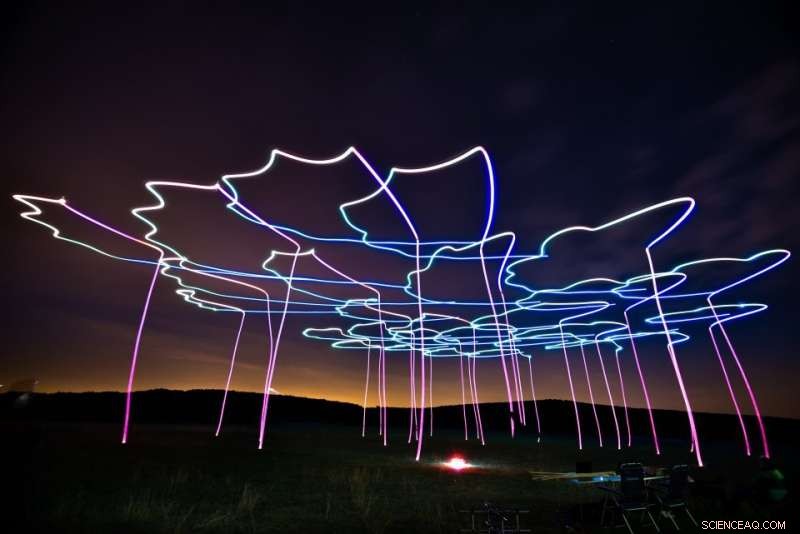
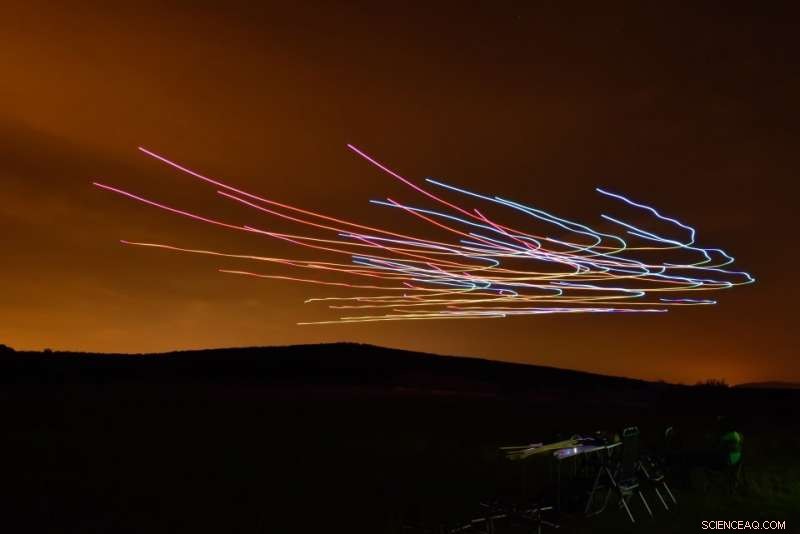
Drones light up the night sky. Credit: Zsolt Bézsenyi
A team of researchers from Hungary, Norway and the Netherlands has found a way to better control a large swarm of drones—give them more autonomy. In their paper published in the journal Science Robotics, the group describes their approach and how well it has worked in real drone swarms.
Most people have seen drone swarms in action—they have been used for colorful entertainment purposes at such events as the Super Bowl and the Olympics. The researchers with this new effort note that such drones are programmed in advance, and are therefore limited in ways they can be deployed. They note that pre-programming makes it almost impossible for drones to overcome unexpected problems such as wind gusts or temporary loss of communications. They suggest a better approach is to make the drones as autonomous as possible so they can determine what to do when unexpected events occur.
Giving swarm drones autonomy has not been easy. The researchers have been working on their project for over six years. The process has involved attaching GPS devices to birds to track and map how they interact in flocks. Simulations were developed to mimic the behavior of 100 birds and then 100 drones. Eventually, the team came up with 11 parameters (such as how quickly to align with other drones) critical for coordinated autonomous flight. They would tweak the parameters and then run a simulation on a supercomputer, note where things went wrong, tweak the parameters and run it again, over and over. Eventually, they report, their simulation became stable enough to convince them to try their approach with real drones.
To test their system, they built their own squad of 30 drones and sent them flying. They report that their squads have performed as hoped—thus far, there have been no collisions. In flight, they look eerily similar to the notorious swarms of starlings flying over Rome. Each of the drones maintains its position in the swarm by keeping in constant communication with the others, monitoring where it is in relationship to others, and how fast everyone is moving. And there is no leader. Each makes its own decisions regarding flight movements based on the movements of the others. The researchers suggest their behavior is very similar to that of flocks of birds or swarms of bees.
Drones light up the night sky. Credit: Zsolt Bézsenyi
© 2018 Tech Xplore