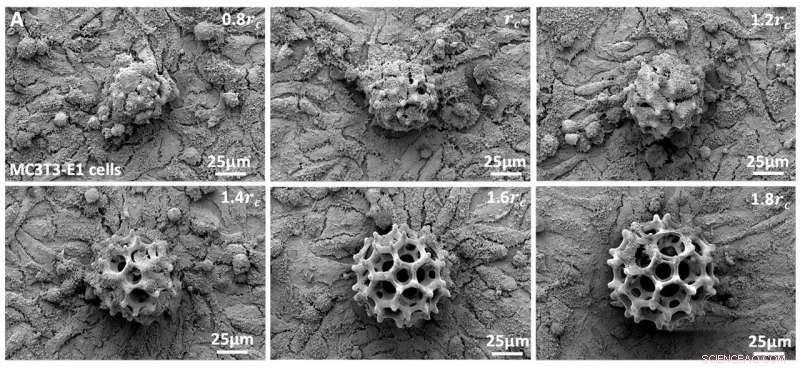
Microrobots of different sizes were found to have different cell-carrying capacities. Credit: Li et al., Sci. Robot. 3, eaat8829 (2018)
A team of researchers at the City University of Hong Kong have found a way to use micro-robots to carry a cluster of cells to a target site in live animals. In their paper published in the journal Science Robotics, the group describes the micro-robots they designed and their performance during testing.
In recent years, scientists have begun looking into the feasibility of using micro-robots to carry drugs or other cargo from one part of the body to another. Such micro-robots could deliver medication, to a specific part of the body that needs it, for example, rather than to the whole body, preventing unwanted side-effects. In this new effort, the researchers were looking for a way to carry a cluster of cells from one location to another inside of a living animal. If such an approach proved possible, micro-robots could be used to carry stem cells to injured body parts, for example, to repair them.
To design a micro-robot suitable for the task, the researchers started by running simulations on a computer looking for the optimal shape. They found that one shaped like a burr (as in, a spiky seed pod) worked the best of all they tried. They used a 3-D printer to create micro-robots with room for a pouch inside for holding stem cells and connective tissue. Then they covered the micro-robots with nickel to make them magnetic, and with titanium for biocompatibility. To move the micro-robot from one place to another, they used a magnet.
They tested their micro-robot idea by injecting several into zebrafish embryos and then successfully manipulating them externally with a tiny magnet. They then filled one of their micro-robots with fluorescent cancer cells and injected it into a live mouse and guided it to a new site where the cancer cells were released. After monitoring the mouse for a few weeks, they found that the micro-robot had successfully released its load—the new location glowed, indicating that the cancer cells had taken hold. The researchers plan to continue their research and expect to begin clinical trials sometime over the next five years.
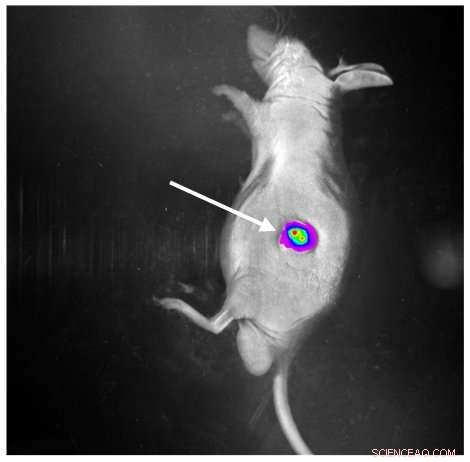
The microrobots with fluorescent HeLa cells were injected into the left dorsum of the nude mice. After four weeks of cultivation, an area with increased fluorescence intensity was observed at the left dorsum of the mouse (indicated by the white arrow), indicating that the tumor was due to the release of HeLa cells from the microrobots. Credit: Li et al., Sci. Robot. 3, eaat8829 (2018)
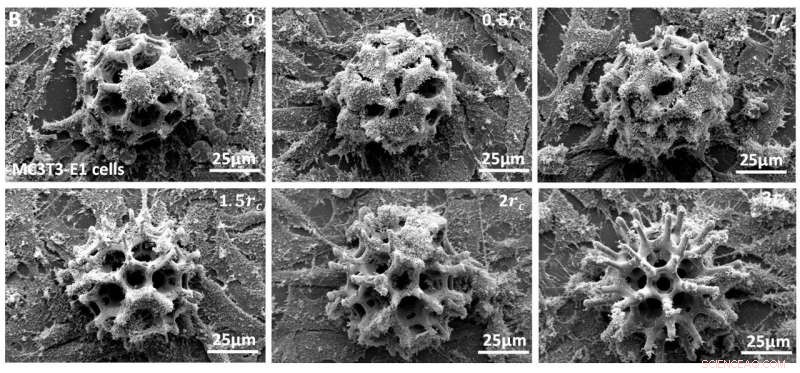
Microrobots of different sizes were found to have different cell-carrying capacities. Credit: Li et al., Sci. Robot. 3, eaat8829 (2018)
© 2018 Tech Xplore