Credit: Science Advances (2018). DOI: 10.1126/sciadv.aas8652
A team of researchers from MIT and Harvard University has come up with a way to get 3-D printers to print objects using data sets rather than geometric representations. In their paper published on the open access site Science Advances, the group describes their new technique and some of the ways they believe it could be used.
Anyone who has seen a modern 3-D printer in action knows that there is a lot of room for improvement. Printed objects are generally a single color and have a blob-like quality. In this new effort, the team at MIT has developed a technique that uses actual data describing an object to print the desired object. The result is comparable to moving from a dot-matrix printer to a laser printer.
To print an object on conventional 3-D printers, calculations are made regarding a digital description of an object, converting the numeric description to geometric shapes that can be used to print an object. The new technique, on the other hand, converts data that describes the digitized image to voxels (3-D pixels). That allows the printer to print voxels instead of shapes, with incredible precision—currently at a resolution of 2.3 million voxels per cubic centimeter.
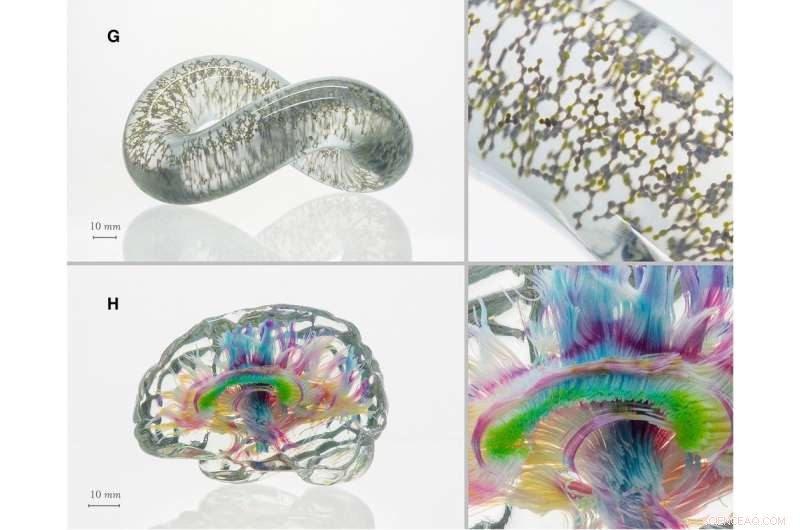
In practice, this means taking data from a source such as an MRI machine, converting it, and then printing it in incredible detail. Additionally, like pixels, each individual voxel contains a color code that can be used to recreate the actual color of the real object—by mixing the familiar magenta, cyan, yellow and black, and of course white and clear. The result is an object that looks very much like the original object, say a human heart, or an ancient artifact. The researchers note that their technique can also be used to create new objects from scratch on a 3-D modeling computer and then print them. To demonstrate, they designed some interesting objects such as a very intricate mask with subtle color changes, and 3-D printed it—and in so doing, gave birth to an entirely new art form.
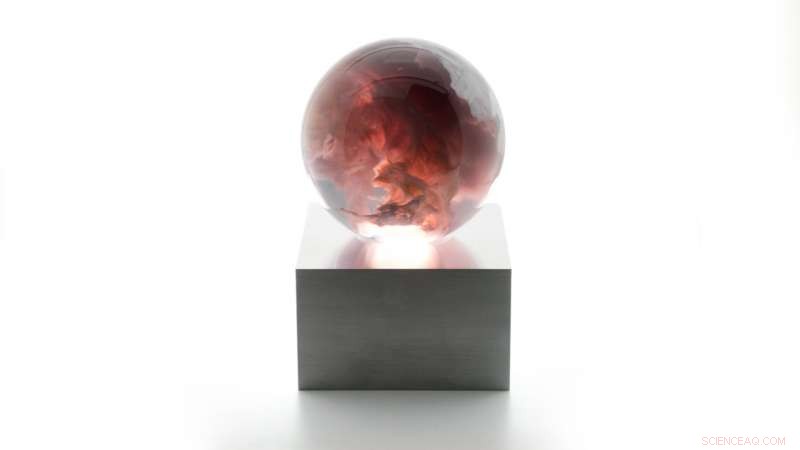
Volumetric 3-D printed high-resolution data objects. Credit: The Mediated Matter Group
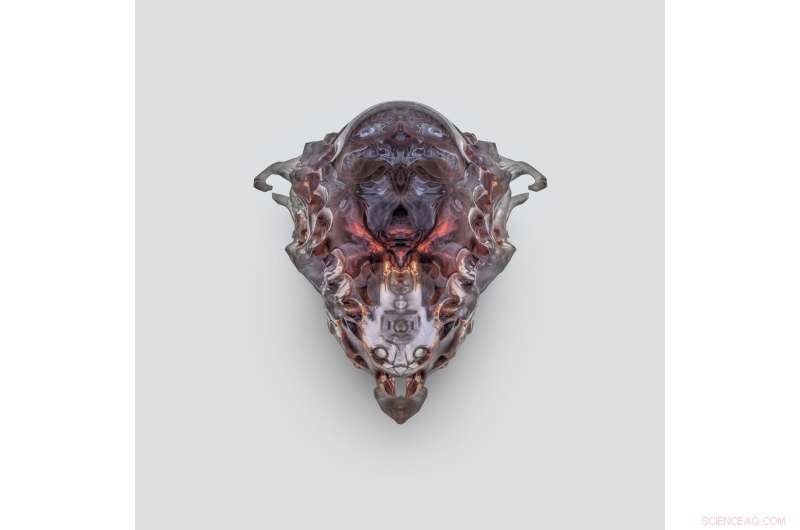
Vespers. Series 2 Mask 1. Front view. Designed by Neri Oxman and members of the Mediated Matter Group for The New Ancient Collection curated and 3-D printed by Stratasys, 2016. Credit: Yoram Reshef
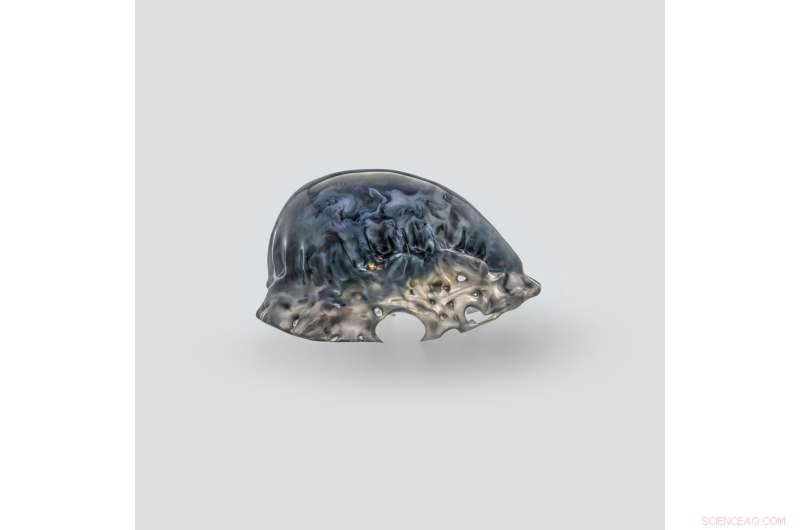
Vespers. Series 2 Mask 2. Side View. Designed by Neri Oxman and members of the Mediated Matter Group for The New Ancient Collection curated and 3-D printed by Stratasys, 2016. Credit: Yoram Reshef
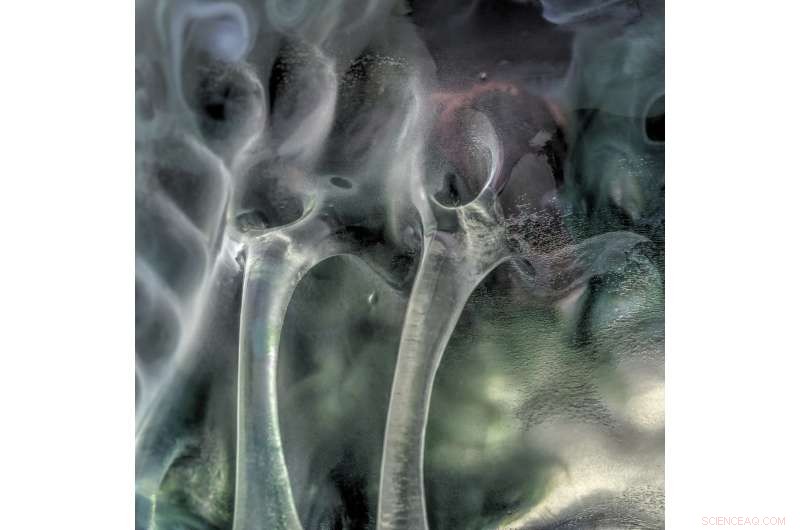
Vespers. Series 2 Mask 4. Close up. Designed by Neri Oxman and members of the Mediated Matter Group for The New Ancient Collection curated and 3-D printed by Stratasys, 2016. Credit: Yoram Reshef
© 2018 Phys.org