Credit: CC0 Public Domain
An international team of researchers has conducted tests to determine if electromagnetic waves from electric vehicles or charging stations might cause problems for people who have cardiac implantable electronic devices (CIEDs). In their paper published in Annals of Internal Medicine, the group describes their study and results.
As electric cars and trucks become more popular, more research is being done to better understand their impact on users. In this new effort, the researchers wondered if electromagnetic waves generated by vehicles powered by electricity rather than gasoline might put certain people at risk—namely, those who have pacemakers or cardioverter defibrillators implanted in their chests. Both use electric signals, one to monitor the heart, the other to jolt the heart if it stops beating.
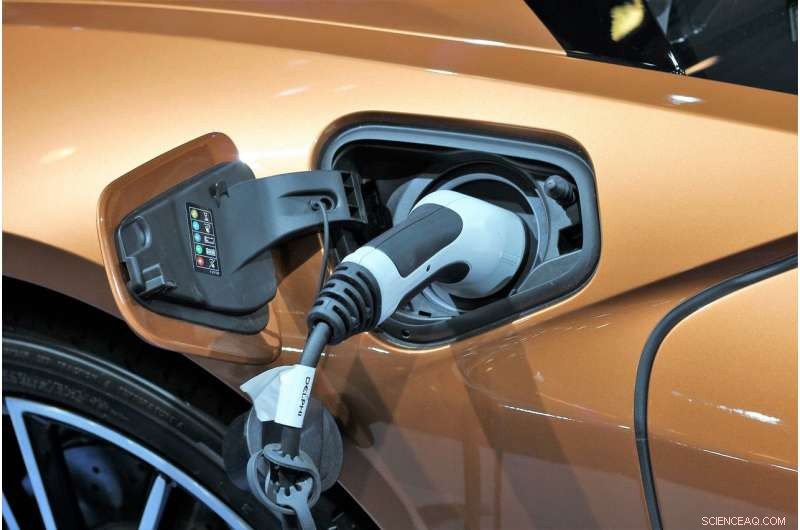
To find out, the researchers conducted a two-pronged test. The first involved 108 subjects with CIEDs who sat in an electric vehicle and who approached a charging station as a vehicle was being recharged. CIEDs keep a record of their activity, which doctors use to monitor patient health and to make adjustment to devices if need be. In this case, the doctors studied data from the CIEDs during the time when the volunteers were tested. The researchers also used multiple types of electric cars (Nissan Leaf, BMW i3, Volkswagen e-up and Tesla Model 85S). In studying the results of analysis by the physicians, the researchers report no abnormalities, which suggests the patients were not impacted by the electric vehicles.
In the second part of the test, the researchers measured electromagnetic radiation exposure during electric vehicle use. They report that as expected, electromagnetic wave strength is strongest when standing next to the cable charging the car. They report that levels were much lower inside the car, likely due to shielding installed by manufacturers. They note also that there was no measurable difference in levels between sitting in the front or rear seats.
The researchers suggest that driving or riding in electric vehicles should be safe for people with CIEDs, but note that their study was small and that both car and CIED technology change over time, so caution is advised.
© 2018 Tech Xplore