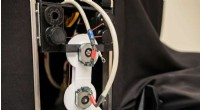
Industrial circuit breakers, devices for interrupting electric current, are typically contained in a cubicle and connected to a heavy conductor, known as a bus and a line via a set of disconnects.
When a breaker is open, it can be moved forward so that it disconnects from the bus and line; this is known as racking the breaker. Racking a circuit is usually accomplished by means of a rotary crank or lever.
Most large, high voltage circuit breakers -- up to 13 kilovolts (kV) -- can be racked in, racked out or to a test position for maintenance. They are typically capable of containing a so-called arc flash (violent, luminous discharge between electric conductors), if operated correctly.
The danger of arc flash, shock or blast when racking a breaker should not be underestimated. For safety, some types of arc-resistant circuit breakers can be racked with the front panel closed to protect workers. A full flash body suit is also recommended to prevent serious injury or death.