Electronics harnesses the motion of electrons within atoms to power countless household devices. Basic electronics refers to the core components—resistors, capacitors, diodes, transistors, inductors, transformers—that form the building blocks of everyday circuits. These parts obey fundamental physics laws, most notably Ohm’s Law, and are powered by a source such as a battery.
All electronic systems operate under Ohm’s Law, which relates voltage (V), current (I), and resistance (R) through the equation V = I × R. Every component in a circuit is engineered to comply with this relationship, ensuring predictable behavior.
The power source—typically a battery or regulated supply—creates the voltage and current that drive the circuit. Voltage is measured in volts (V), while current is measured in amperes (A).
A resistor resists the flow of electrons, converting electrical energy into heat. Its resistance is expressed in ohms (Ω), with common sub‑units kilohms (kΩ) and megohms (MΩ). In series, resistances add; in parallel, the equivalent resistance decreases.
Capacitors store electrical energy and release it when needed. Their capacitance is measured in farads (F), with practical sub‑units microfarads (µF) and picofarads (pF). Parallel connections increase total capacitance, while series connections reduce it.
Diodes permit current to flow in a single direction, making them essential for rectification and signal control. Transistors, with three terminals, can amplify signals or act as switches, enabling complex logic and modulation.
Inductors generate magnetic fields from current flow, whereas capacitors generate electric fields. Together with resistors, they form RLC circuits that can be tuned to specific frequencies. Transformers transfer electrical energy between circuits while stepping voltage up or down.
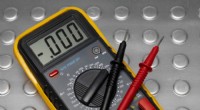
Accurate measurement is vital. Common tools include:
These instruments enable engineers and hobbyists to troubleshoot, calibrate, and innovate within basic electronic systems.