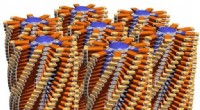
* Red Blood Cell: Roughly 6-8 micrometers in diameter.
* Transistor Gate: In modern transistors, the gate length can be as small as a few nanometers (a nanometer is one billionth of a meter).
The key takeaway: Transistor gates are significantly smaller than red blood cells. Imagine a red blood cell as a basketball; a transistor gate would be roughly the size of a grain of sand compared to that basketball.
Here's a more detailed breakdown:
* Scale: Red blood cells are on the order of micrometers (µm), while transistor gates are on the order of nanometers (nm). There are 1000 nanometers in one micrometer.
* Size Difference: A transistor gate is roughly 1000-10,000 times smaller than a red blood cell.
This massive size difference is a key factor in the ongoing miniaturization of electronics. By shrinking transistors, we can pack more and more components onto microchips, leading to smaller, faster, and more powerful devices.