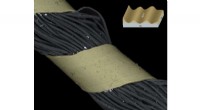
A new class of hybrid semiconductors has been developed that exhibits zero thermal expansion, a property that could make them ideal for use in a variety of electronic and optoelectronic devices.
The new materials, which are made from a combination of organic and inorganic materials, have been shown to have a coefficient of thermal expansion (CTE) of zero parts per million per degree Celsius (ppm/°C). This means that they do not expand or contract when heated or cooled, making them ideal for use in applications where precise dimensional control is required.
The CTE of a material is a measure of how much it expands or contracts when heated or cooled. A material with a high CTE will expand more than a material with a low CTE. This can be a problem for electronic and optoelectronic devices, as the expansion or contraction of the material can cause the device to malfunction.
The new hybrid semiconductors offer a number of advantages over traditional materials. In addition to their zero CTE, they are also lightweight, flexible, and have a high electrical conductivity. This makes them ideal for use in a variety of applications, including:
* Electronic packaging: The new materials can be used to package electronic components, protecting them from the effects of temperature fluctuations.
* Optoelectronics: The materials can be used to make optical devices, such as lasers and detectors, that are not affected by temperature changes.
* MEMS devices: The materials can be used to make microelectromechanical systems (MEMS) devices, such as accelerometers and gyroscopes, that require precise dimensional control.
The new hybrid semiconductors are still in the early stages of development, but they have the potential to revolutionize a variety of electronic and optoelectronic applications. Their unique properties could enable the development of new devices that are more reliable, efficient, and compact than existing devices.