Researchers at the University of California, Berkeley, have discovered a new way that materials transfer heat, which could lead to improved electronics and other devices.
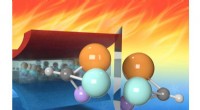
The team, led by physicist Xiang Zhang, found that when two materials with different thermal properties are brought into contact, the heat transfer between them is not simply a matter of conduction, convection, or radiation. Instead, there is also a fourth mechanism, which they call "interfacial thermal conductance."
Interfacial thermal conductance is the transfer of heat across the interface between two materials. It is different from conduction, which is the transfer of heat through a material, and convection, which is the transfer of heat by the movement of a fluid.
The researchers found that interfacial thermal conductance can be very high, even when the two materials have very different thermal properties. This means that it could be possible to use interfacial thermal conductance to improve the heat transfer in electronic devices, such as computer chips and solar cells.
"This discovery could have a major impact on the design of electronic devices," said Zhang. "By understanding how interfacial thermal conductance works, we can design materials and structures that can transfer heat more efficiently."
The team's findings were published in the journal Nature Materials.
Potential applications of interfacial thermal conductance
The discovery of interfacial thermal conductance could have a number of potential applications in electronics and other fields. Here are a few examples:
* Improved heat transfer in computer chips: Computer chips generate a lot of heat, which can lead to performance problems. By using materials with high interfacial thermal conductance, it could be possible to improve the heat transfer in computer chips and keep them running cooler.
* More efficient solar cells: Solar cells convert sunlight into electricity, but some of the sunlight is lost as heat. By using materials with high interfacial thermal conductance, it could be possible to improve the efficiency of solar cells and capture more of the sunlight.
* Better thermal insulation: Thermal insulation is used to reduce heat transfer between two objects. By using materials with low interfacial thermal conductance, it could be possible to create more effective thermal insulation.
The discovery of interfacial thermal conductance is a promising new development that could lead to a number of advances in electronics and other fields. By understanding how interfacial thermal conductance works, researchers can design materials and structures that can transfer heat more efficiently and improve the performance of electronic devices.