Quantum Bits (Qubits):
Qubits are the basic units of information in quantum computing, similar to classical bits in traditional computers. However, qubits can exist in a superposition of states, allowing them to perform complex computations exponentially faster than classical computers for certain problems.
Photonic Qubits:
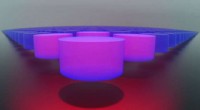
In the "egg carton of light" approach, photons (particles of light) are used to create and manipulate qubits. Photons can be trapped and controlled within carefully designed optical structures that resemble an egg carton. These structures are made of photonic crystals or other materials that exhibit periodic variations in their refractive index.
Trapping Photons:
By exploiting the properties of photonic crystals, researchers can create tiny optical cavities that act like "egg cups" to trap photons. These cavities are designed to have specific resonant frequencies that match the energy levels of the qubits. When photons are introduced into these cavities, they become trapped and can be manipulated using various techniques.
Quantum Gates and Operations:
Quantum gates are the basic building blocks of quantum circuits, analogous to logic gates in classical computers. In the "egg carton of light" approach, quantum gates are implemented using controlled interactions between the trapped photons. By carefully designing the optical structures and manipulating the photons' properties, researchers can perform various quantum operations, such as rotations and entangling gates.
Advantages:
The "egg carton of light" approach offers several advantages for quantum computing:
1. Compactness: Photonic qubits can be packed densely within the optical structures, resulting in extremely compact quantum computers. This is crucial for scaling up the number of qubits and achieving higher computational power.
2. Energy Efficiency: Photons are massless particles that require very low energy to manipulate, making photonic quantum computers highly energy-efficient compared to other approaches.
3. Long Coherence Times: Photons have long coherence times, which means they can maintain their quantum states for longer durations, reducing the risk of errors in quantum computations.
4. Scalability: The "egg carton of light" approach can be scaled up to larger numbers of qubits by creating arrays of optical cavities and interconnecting them. This scalability is essential for tackling complex quantum algorithms.
Challenges:
Despite its potential, the "egg carton of light" approach faces several challenges:
1. Fabrication: Creating precise optical structures with the required properties is a complex and challenging task, requiring advanced nanofabrication techniques.
2. Noise and Errors: Photons are susceptible to noise and decoherence from interactions with the environment, leading to errors in quantum computations. Mitigation strategies are necessary to minimize these errors.
3. Scalability: Scaling up to large numbers of qubits while maintaining coherence and control remains a significant challenge.
Outlook:
The "egg carton of light" approach represents an innovative and promising direction for quantum computing. While it is still in the early stages of development, ongoing research and advancements in photonic technologies hold the potential to overcome the challenges and pave the way for compact, powerful, and energy-efficient quantum computers in the future.