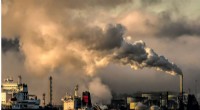
Industrial pollution can lower the pH of precipitation, creating acid rain. This type of precipitation can directly kill some organisms, like trees and fish, devastating ecosystems. While acid rain does not affect humans as dramatically, it can indirectly cause health problems, particularly lung issues. Acid rain has decreased since the late 1970s in North America, where tighter U.S. regulations have improved air quality.
All rainwater has a slightly acidic pH due to ambient levels of carbon dioxide in the air. Certain industrial pollutants, however, can decrease the pH excessively, causing it to pose a danger to the environment. Sulfur dioxides and nitrogen oxides, for example, can have a dramatic effect on rainwater's pH. Rain contaminated by these compounds changes the pH of water and soil, making them more acidic. Certain trees and fish have adapted to specific pH levels, and changes can kill them, leaving parts of forests, lakes and rivers devoid of life.
While acid tends to bring to mind the image of corrosive chemicals dissolving metals and other materials, acid rain does not have direct effects on human health. Acid rain does not have an acidic enough pH to burn human skin. According to the U.S. Environmental Protection Agency, "Swimming in an acidic lake or walking in an acidic puddle is no more harmful to people than swimming or walking in clean water." While acid rain cannot burn your skin, it is linked to several indirect health effects.
Everything is connected in air quality. While acid rain cannot harm humans directly, the sulfur dioxide that creates it can cause health problems. Specifically, sulfur dioxide particles in the air can encourage chronic lung problems, like asthma and bronchitis. Additionally, the nitrogen oxides that create acid rain promote the formation of ground-level ozone. While ozone high above the Earth helps block ultraviolet radiation, ground-level ozone promotes severe lung problems like chronic pneumonia and emphysema.
In some ways, the reduction of acid rain in the United States is one of the biggest successes of environmental policy. Since the 1970s, various laws have reduced the emission of sulfur dioxides and nitrogen oxides from power plants, including the Clean Air Act of 1970 and the Canada-United States Air Quality Agreement of 1991. The longest continuous rain-chemistry monitoring station in North America, the Hubbard Brook Experimental Forrest in New Hampshire, found that hydrogen ion concentration (pH) decreased by roughly 60 percent since the 1960s. The EPA estimates that the reduction in acid rain-producing emissions has saved $50 billion in health care costs. Despite the overall positive picture, some areas in New England are still recovering.