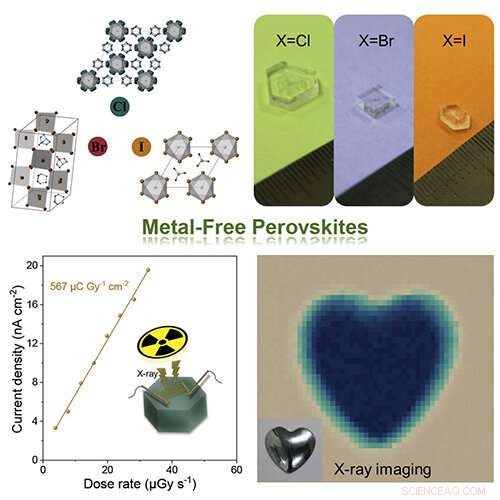
Metal-free perovskite series, DABCO-NH4X3 (X = Cl, Br, I), exhibit a remarkable variety of perovskite-type structures through halide modulation, therefore their single crystals grown at the same condition show different crystal morphology . Credit: DUAN Lianjie
Metal-free halide perovskites are novel candidates for ferroelectrics and X-ray detection. However, the molecular self-assembly of these perovskites and its influence remain unexplored.
Recently, a research group led by Prof. Liu Shengzhong from the Dalian Institute of Chemical Physics (DICP) of the Chinese Academy of Sciences (CAS) fabricated halide-modulated self-assembly of metal-free perovskite single crystals for bio-friendly X-ray detection.
This study was published in Matter on June 14.
Molecular self-assembly plays a critical role in crystal engineering for the design and fabrication of novel metal-free perovskite compounds.
After preparing DABCO-NH4X3 (X = Cl, Br, I) single crystals, the researchers investigated halide-modulated molecular assembly via hydrogen bonding in metal-free perovskites and its influence on their crystal packing, band nature, mechanical and electrical properties, as well as final optoelectronic performance.
They found that the crystal DABCO-NH4I3 with superior in-plane charge transport and lower charge effective mass exhibited higher carrier mobility. Therefore, it presented better X-ray detection sensitivity, reaching 567 μC Gyair-1 cm-2. Meanwhile, they demonstrated the feasibility of X-ray imaging had a well-defined 'heart' image.
A variety of non-metallic and organic groups readily were available for the A, B and X in crystal DABCO-NH4I3, resulting in fine-tuned properties and free of associated toxicity.
"This work benefited the understanding of molecular self-assembly behavior and was intended to inspire activities to study an assortment of novel ABX3 perovskite materials for potential biological and therapeutic applications," said Prof. Liu.