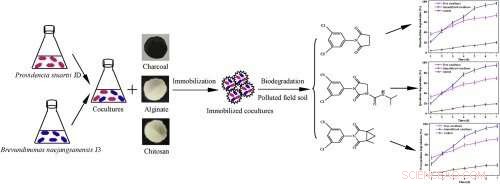
Graphical abstract. https://doi.org/10.1016/j.jhazmat.2020.123888
Dicarboximide fungicides dimethachlon, iprodione and procymidone have been widely used worldwide to control plant diseases in recent decades. Due to widespread and inappropriate application of these fungicides, their residues are often found in water, soil and farm products, posing risks to the environment, wildlife and human beings.
Biodegradation is extensively and preferentially used in pollution control due to its effectiveness, eco-friendliness, economy and expedience compared with other methods.
A joint research team led by Prof. Wu Yanyou from the Institute of Geochemistry of the Chinese Academy of Sciences (IGCAS) and Prof. Wu Xiaomao from Guizhou University studied the enhancement of dicarboximide fungicide degradation by two bacterial co-cultures of Providencia stuartii JD and Brevundimonas naejangsanensis J3.
The researchers found that the two bacterial cocultures of JD and J3 could enhance the biodegradation of dicarboximide fungicides, and effectively degrade dimethachlon, iprodione and procymidone to simple structure and low-toxicity products.
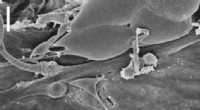
Additionally, the JD+J3 co-cultures that were immobilized in a charcoal-alginate-chitosan carrier evidently exceeded the free co-cultures in terms of degradability, stability and reusability.
The results also showed that after seven days of applying the immobilized JD+J3 co-cultures in field brunisolic soils, the degradation rates of dimethachlon, iprodione and procymidone reached 96.74%, 95.02% and 96.27%, respectively.
Meanwhile, the immobilized JD+J3 cocultures exhibited faster degradation compared to free cocultures and natural dissipation. The study was published in Journal of Hazardous Materials.