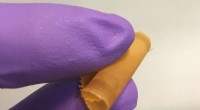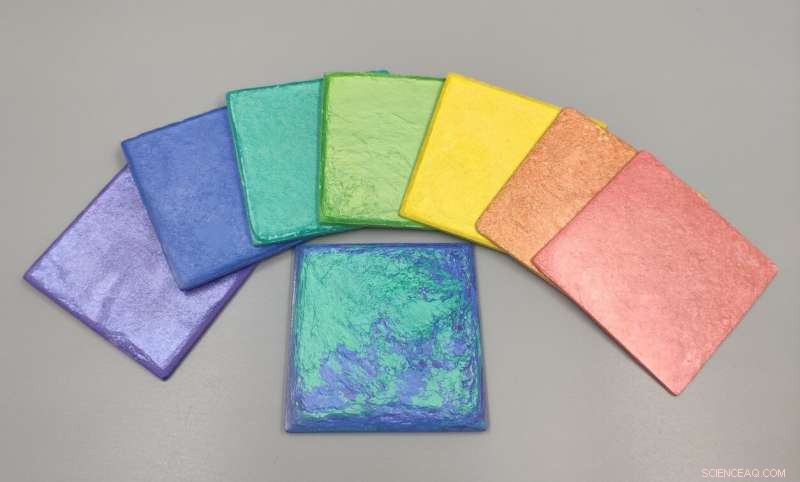
Based on different commercially available raw materials (e.g., TiO2-mica, Fe2O3-mica), a variety of all-natural bioinspired structural materials with different colors can be fabricated. Credit: GUAN Qingfang
Modern life relies heavily on plastics, even though their petroleum-based production creates serious environmental challenges. Industry currently lacks sustainable alternatives due to their limited mechanical properties or complex manufacturing processes. An advanced strategy to design and produce high-performance sustainable structural materials is hence greatly needed.
Just such a new bioinspired material is now available to replace petroleum-based plastics. A team led by Prof. Shu-Hong Yu from the University of Science and Technology of China (USTC) reports a method to manufacture materials with similar structure as nacre from wood-derived fiber and mica, with adaption to mass production, good processability, and tunable coloration.
Natural nacre has a hierarchically ordered structure at multiscale levels, just like bricks and mortar, enabling it to be of both strength and toughness. Inspired by nacre, the researchers mimic the ordered brick-and-mortar structure using the TiO2 coated mica microplatelet (TiO2-mica) and cellulose nanofiber (CNF) by the proposed directional deforming assembly method.
This method directly presses the hydrogel of TiO2-mica and CNF, while keeps the size on in-plane directions unchanged. The thickness of the hydrogel is dramatically reduced and materials are directly constructed with the highly ordered brick-and-mortar structure.
At the nanoscale, the TiO2 nano-grains on the surface of TiO2-mica lead to efficient energy dissipation by frictional sliding during TiO2-mica pull-out. All the hierarchically ordered structure at multiscale levels contribute to the load redistribution and toughness enhancement.
A mobile phone case prototype made from this bioinspired material. Thanks to its good processability, the material can be fabricated into desired shape and size, showing a vast potential to replace plastics for practical applications, for example, structural support for high-end personal electronic device. Credit: GUAN Qingfang
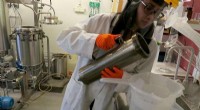
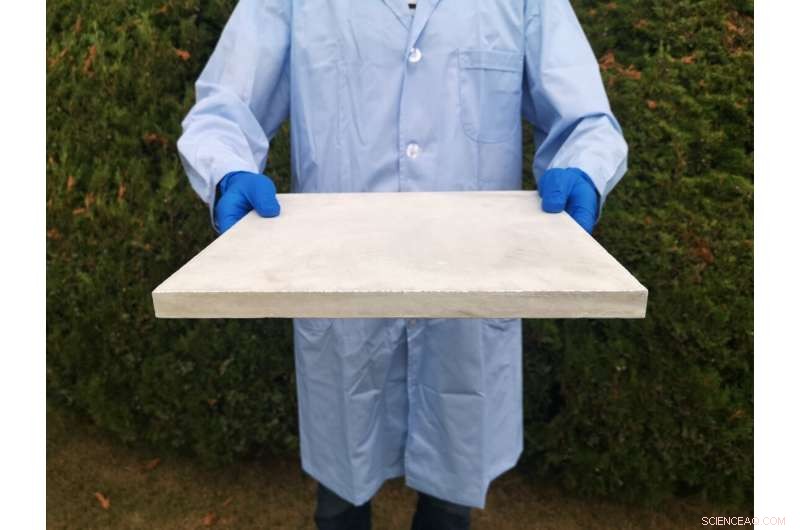
Because the proposed manufacture method, directional deforming assembly, is effective and scalable, mass production of all-natural bioinspired structural material can be achieved. Credit: GUAN Qingfang
The obtained materials have excellent strength (~281 MPa) and toughness (~11.5 MPa m1/2), which are more than 2 times higher than those of high-performance engineering plastics (e.g., polyamides, aromatic polycarbonate), making it a strong competitor to petroleum-based plastics.
Even better, these materials adapt to temperature ranging from -130 °C to 250 °C, while normal plastics easily soften at high temperature. Therefore, such materials are safer and more reliable at high or variable temperatures.