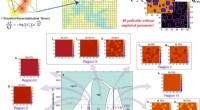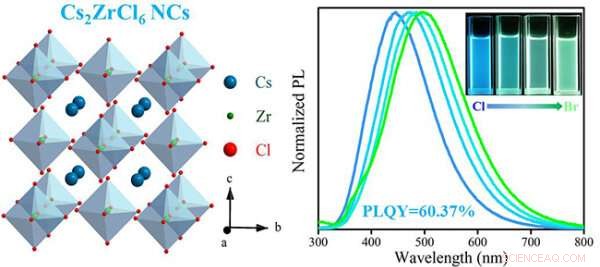
Lead-free perovskite Cs2ZrCl6 NCs with a PLQY up to 60.37% is synthesized. Credit: LIU Siping and YANG Bin
In recent years, all-inorganic CsPbX3 (X = Cl, Br, I) perovskite nanocrystals have attracted extensive research attention due to their excellent photoelectric properties. However, the problems of Pb toxicity and poor stability hinder their practical application.
A research group led by Prof. Han Keli from the Dalian Institute of Chemical Physics (DICP) of the Chinese Academy of Sciences (CAS) synthesized vacancy ordered Cs2ZrCl6-x(0≤x≤1.5) double perovskite nanocrystals (NCs) for the first time via hot injection method.
This study was published in Angewandte Chemie International Edition on August 22.
The Cs2ZrCl6 NCs exhibited long-lived triplet excited state, featuring highly efficient photoluminescence (PL) quantum efficiency due to thermally activated delayed fluorescence.
The scientists also revealed the mechanism of TADF by detailed experimental characterizations including temperature-dependent photoluminescence spectra, temperature-dependent time-resolved photoluminescence spectra, nanosecond transient emission spectra, and pump-probe femtosecond time-resolved spectra.
TADF is promising luminescence mechanism for obtaining high exciton utilization. It is common in solid organic molecules or metal-organic complexes, but rarely reported in all-inorganic colloidal nanocrystals.
The study provides a unique strategy for the development of new inorganic phosphors.