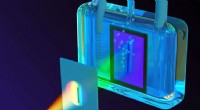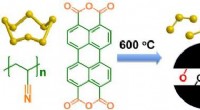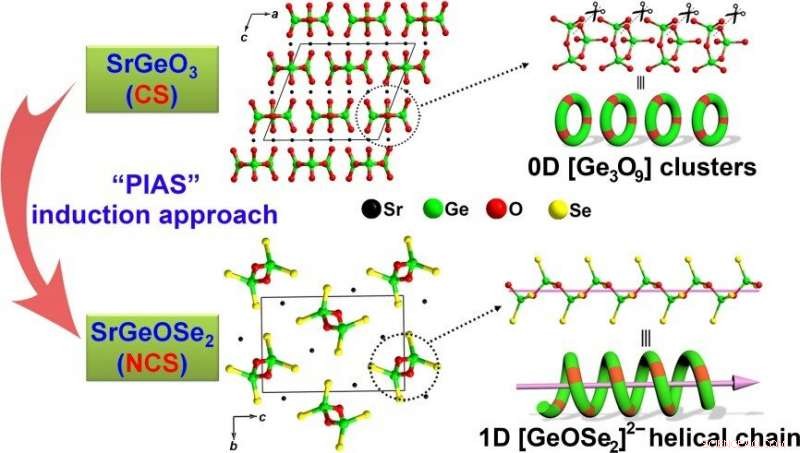
Structural transformation from CS compound SrGeO3 to the NCS SrGeOSe2. Credit: Prof. ZHU’s Group
Infrared nonlinear optical (IR–NLO) materials are crucial for a broad range of applications, such as signal communication, microscopy and data processing. Yet, the challenge is how to obtain a strictly structural non-centrosymmetric (NCS) compound, which is the primary requirement for the IR–NLO materials.
In a study published in Chemistry of Materials, the research team led by Prof. Zhu Qilong and Prof. Lin Hua from Fujian Institute of Research on the Structure of Matter (FJIRSM) of the Chinese Academy of Sciences proposed a partial isovalent anion substitution (PIAS) strategy to design and synthesize a novel IR–NLO material SrGeOSe2.
The researchers have, for the first time, reported the structural transformation from centrosymmetric (CS) compound SrGeO3 to NCS SrGeOSe2 through a generic and effective PIAS strategy.
They found that SrGeOSe2 exhibits the desired balance between a strong powder second harmonic generation efficiency (SHG = 1.3 × benchmark AgGaS2) and a large laser-induced-damage threshold (LIDT = 36 × benchmark AgGaS2).
Theoretical calculations indicated that the large second-harmonic generation (SHG) efficiency mainly originates from the cooperative effects of 1-D heteroligand [GeO2Se2] asymmetric building units.
This study provides a powerful way to rationally induce the symmetry breaking and enhance the local dipole moments of the active units.