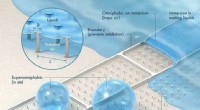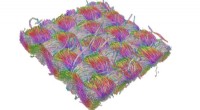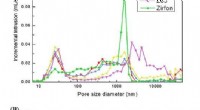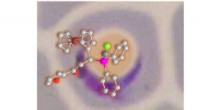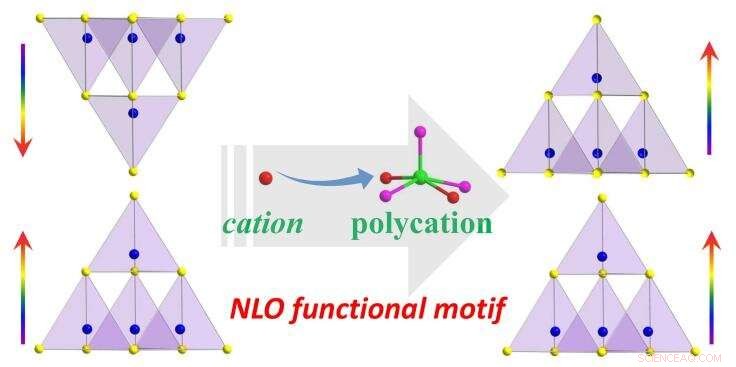
Schematic illustration of reconstructing NLO-functional motif in a parallel fashion via polycation-substitution-induced CS-to-NCS transformation strategy. Credit: Prof. GUO’s group
Nonlinear optical (NLO) crystals possess a frequency conversion capability that is significant for national defense and civil applications. Noncentrosymmetry (NCS) is a prerequisite for second-order NLO materials, but designing NCS structures is a challenging task.
In a study published in the Journal of the American Chemical Society, a group led by Prof. Guo Guocong at Fujian Institute of Research on the Structure of Matter (FJIRSM) of the Chinese Academy of Sciences, reported two novel NCS salt-inclusion chalcogenides: ABa2Cl and Ga4S8 (A = Rb, Cs), which are the first examples achieved through polycation-substitution-induced centrosymmetry (CS)-to-NCS transformation and NLO-functional motif ordering.
The researchers constructed the [Ga4S8]4- layers in RbGaS2 by apex-sharing T2-supertetrahedra Ga4S10. Although the [Ga4S8]4 unit is NLO-active, RbGaS2 cannot produce second harmonic generation (SHG) efficiency because the neighboring [Ga4S8]4 layers in its structure stack in a back-to-back style, which results in a CS space group of C2/c and cancels out their hyperpolarizabilities.
Therefore, the researchers succeeded in replacing the Rb+ in RbGaS2 with acentric polycation [ClA2Ba3]7+ via the salt-inclusion synthesis method, affording two new NCS sulfides, [ABa2Cl][Ga4S8] (A = Rb, Cs).
They discovered that the orderly arrangement of NLO-active T2-supertetrahedral Ga4S10 motifs resulting from the template effect of polycation [ClA2Ba3]7+ is responsible for the remarkable SHG intensities (10.4–15.3× KH2PO4 (KDP) at 1064 nm; 0.9–1.0×AgGaS2 at 1910 nm).
Those experimental results, together with high laser-induced damage thresholds (11–12×AgGaS2), wide transparent window (0.4-12.3 μm), and phase-matchable behavior, indicate that [ABa2Cl][Ga4S8] (A = Rb, Cs) are promising wide-spectrum NLO materials used in both Vis and IR regions.
This study provides an effective approach for designing new NLO materials.