Credit: Duke University
On solar farms in particularly dusty places in the world, like the Arabian Peninsula and parts of India and China, air pollution costs the solar energy industry tens of billions of dollars annually. As particles settle out of the air onto the surfaces of solar panels, they constrain the panels' potential. Workers with soapy brushes can clean the grime from the panels, much as you might clean your windshield at a car wash. But in many of these areas, water is scarce and cleaning is expensive, so there's a tradeoff—spend precious resources and labor, or sacrifice solar energy output.
Environmental engineers in professor Mike Bergin's lab are trying to figure out how solar farms can best navigate that tradeoff, by developing a schedule by which solar farmers could clean most efficiently. Gaining a better understanding of what exactly is depositing on solar panels, how that affects energy production and how those effects vary by region throughout the year could help them the most effective cleaning schedule, according to Michael Valerino, a Ph.D. student in Bergin's lab.
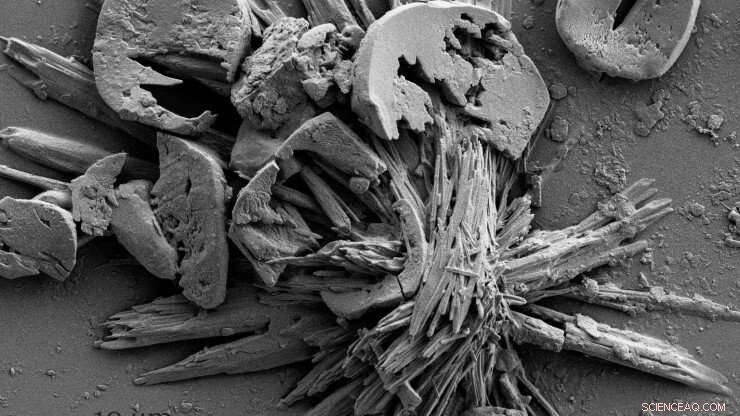
To do that, the engineers study all kinds of images of solar panels. Most are taken with low-cost digital microscopes that let them see how much of the surface is obscured by dust, acting as a low-cost soiling sensor. But they also use the more advanced optical microscopes available in the Duke Light Microscopy Core Facility and the scanning electron microscope, or SEM, housed in Duke's Shared Materials Instrumentation Facility, to zoom in for a closer look at the tiny bits of flotsam and jetsam that glom together to obscure the panels.
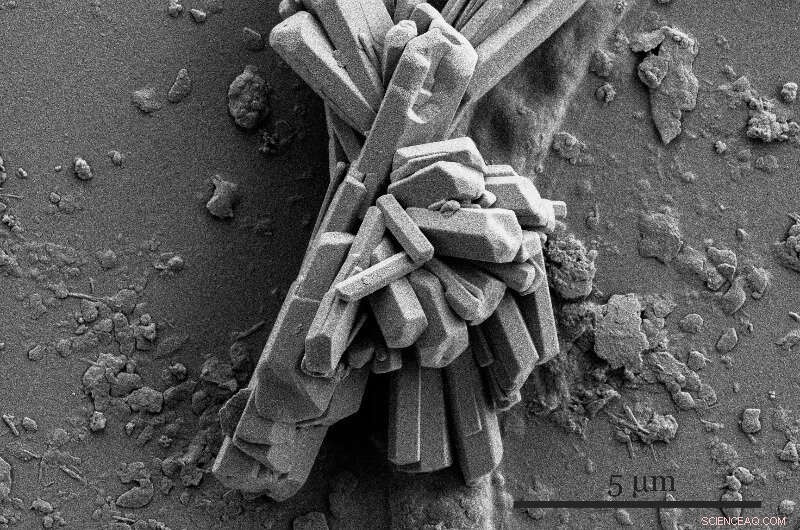
“I’m telling you, it’s a whole other universe when you zoom in with the SEM, at the surface of these panels with dust on them,” said Valerino. “You’ll see anything from what looks like cubes of salt—these perfect square things—to these big, long filamentous particles.” Credit: Duke University
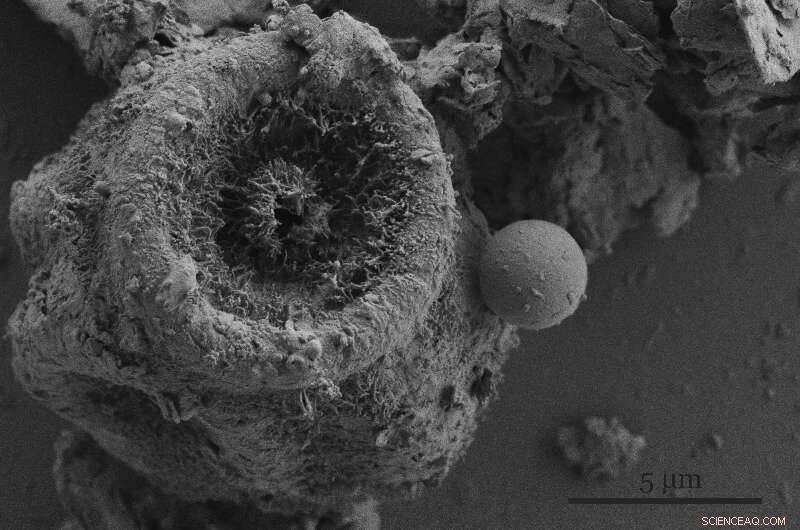
“You can find fungal deposits,” said Valerino. “You’ll have these big giant hunks of dust on them that are porous and non-uniform.” Credit: Duke University
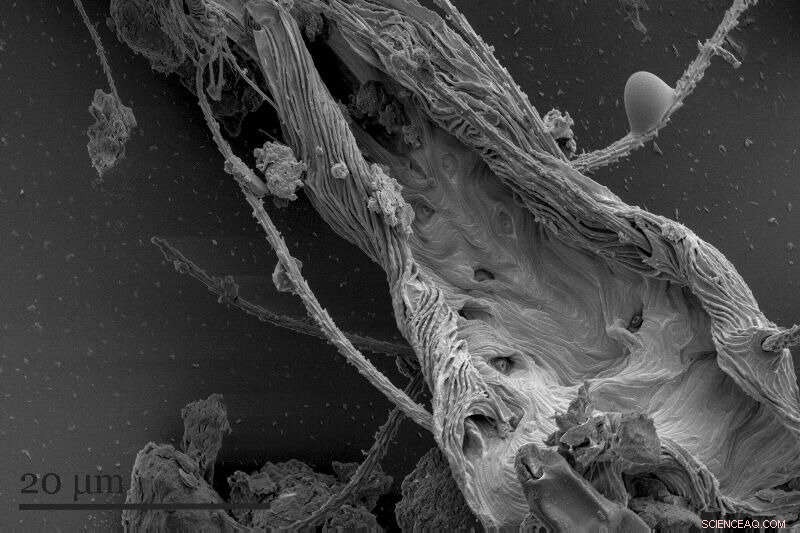
“At one point I swear I found what looked like an exploded insect. You could see that looked like an insect leg, but it looked like a little tiny bomb had gone off inside it.” Credit:
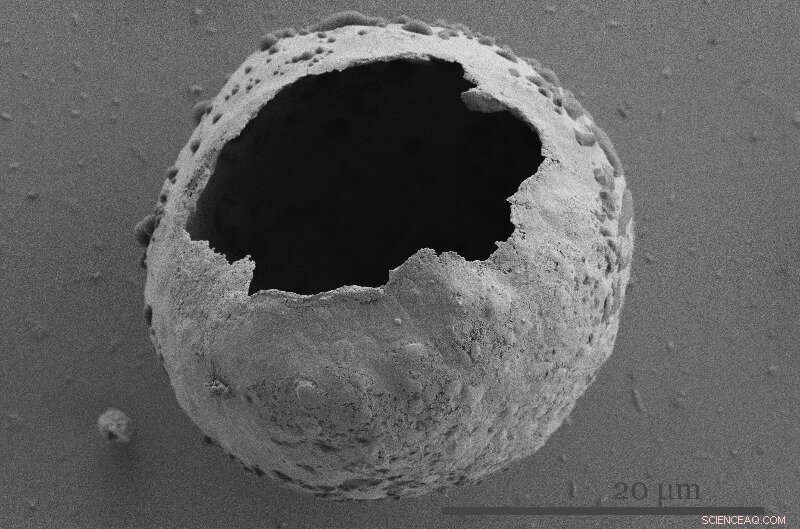
Credit: Duke University
"We use advanced optical microscopy for size analysis," said Valerino. "The SEM gives us information about the size, shape and composition of the particles, which in turn gives us a pretty good idea of where they came from—whether it's something like desert dust, or particles from vehicular emissions," said Valerino. He then uses energy dispersive X-ray spectroscopy to get more information about the particles' composition, based on the electrons the particles eject when blasted with X-rays.
Valerino said that looking at soiled surfaces with the SEM at different times of the year gives the group a better idea of how those factors create energy losses, because factors like humidity can change the size, shape, distribution and even the composition of the particles on the surface—right after a light rainfall, for example, the particles can become stickier and more difficult to remove.
Valerino magnifies the particles to 2000, 5000 or even 8000 times their actual size to get the best possible look.