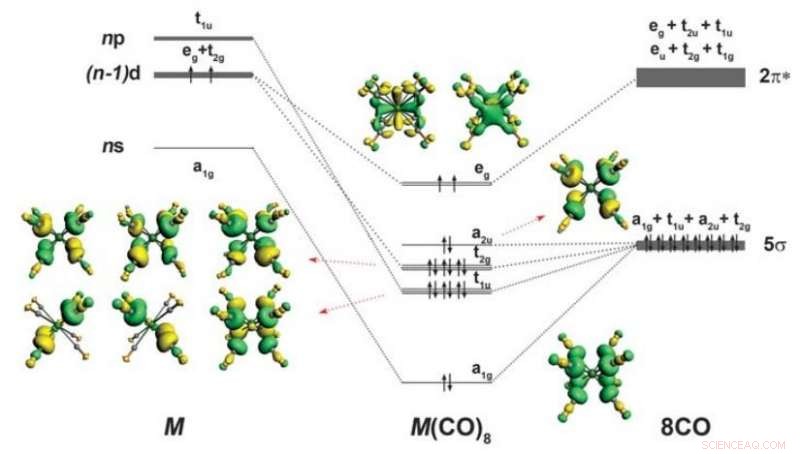
Bonding scheme and shape of the occupied valence orbitals of M(CO)8 (M = Ca, Sr, or Ba). Splitting of the spd valence orbitals of an atom M with the configuration (n − 1)d2ns0np0 in the octacoordinate cubic (Oh) field of eight CO ligands is also given. Only the occupied valence orbitals that are relevant for the M-CO interactions are shown. Up and down arrows indicate electrons with opposite spin. Credit: Science (2018). DOI: 10.1126/science.aau0839
A team of researchers from Fudan University and Nanjing Tech University, both in China, has demonstrated that the 18-electron principle is not limited to transition metals. In their paper published in the journal Science, the group describes their work with calcium, strontium and barium atoms and what they found. P. B. Armentrout with the University of Utah offers a Perspective piece on the work done by the team in China in the same journal issue.
As many chemistry students will remember, elements in the periodic table are classified into main group elements divided by blocks—they include the s and p blocks, the d block, which includes transition metals, and of course, the f block, which includes actinides and lanthanides. Also, the main group elements calcium, strontium and barium are known to form bonds using their orbitals, and follow what is known as the octet rule—where atoms wind up with eight electrons in their valence shell. Transition metals, on the other hand, have another five d orbitals which when filled result in a stable formation with 18 electrons. In this new effort, the researchers have shown that even main group elements like calcium, strontium and barium can be made to follow the octet rule, demonstrating that the octet rule is not limited to just transition metals. The group suggests this finding indicates that the old octet rule, which is found in virtually all chemistry textbooks, is not actually correct in some instances.
In their work, the researchers showed that main group elements could form 18-electron complexes with carbon monoxide when put in a very cold chamber. They report that they were studying Ba(CO)+ and Ba(CO)- using spectral analysis when they found something amiss—the wavenumbers for the C-O stretching mode were oddly shifted. An analysis of their findings suggested that the Ba atoms had d orbitals rather than the expected s or p orbitals. To demonstrate their theoretical findings, they placed mixes of Ba, Sr and Ca in a cold neon matrix and used infrared spectroscopy to get a better look at what was going on—they found evidence of eight CO ligands and back-bonding—a demonstration of non-transition metals following the octet rule.
© 2018 Phys.org