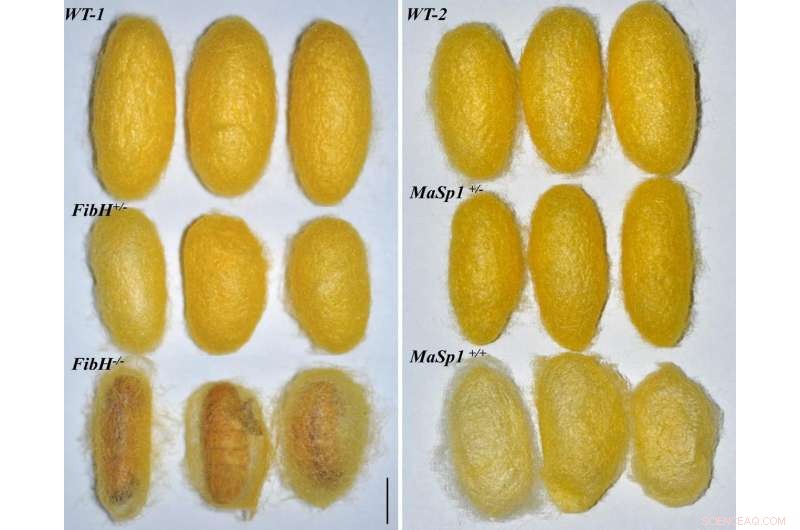
An analysis of transformed cocoons. Morphology of the WT-1, FibH+/-, FibH-/-, WT-2, MaSp1+/-, and MaSp1+/+ cocoons. Scale bar represents 1 cm. Credit: Jun Xu
A team of researchers affiliated with several institutions in China has succeeded in using a gene editing technique to get silkworms to produce spider silk. In their paper published in Proceedings of the National Academy of Sciences, the group describes the technique they used and the quality of the silk produced.
In recent years, scientists have discovered that the unique attributes of spiker silk make it useful in a number of applications. One group found, for example, that it could be used to create micro-capsules for delivering cancer drugs. Another found that it could be used to repair damaged nerves, and yet another found it could make bulletproof vests stronger. Thus, biological researchers have sought ways to produce spider silk commercially, but have come up short. Efforts to farm them like silkworms have failed due to the erratic nature and aggressive behavior of spiders. And efforts to genetically alter other critters have come up short, as well. In this new effort, the researchers tackled the latter approach and report that they have found a way to succeed where others have failed.
Rather than using the more familiar CRISPR gene editing technique, the researchers chose instead to use an editing technique called TALEN—it is a method that uses so-called "molecular scissors" to operate on DNA. Using the technique, the team replaced one part of a silkworm genome with a snippet from a golden orb-web spider to produce a spider-silk making silkworm.
The researchers report that their efforts resulted in silkworms able to produce silk that was a mixture of that normally produced by the silkworm and the spider. Testing showed that the silk was 35.2 percent spider, which was a big improvement over the work of other teams, which were only able to achieve approximately 5 percent. The newly improved silk was also ready for use as spun by the silkworms, as opposed to results obtained by other teams. The researchers note that the process also allows for creating custom silks depending on need. They suggest their technique lends itself very well to mass production, making it a viable option for future applications.
© 2018 Phys.org