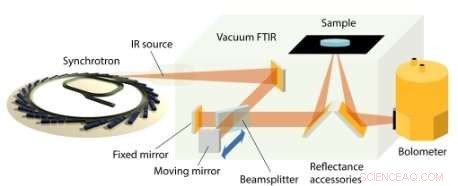
Figure 1: The experimental setup for measuring the broadband IR reflectivity of polycrystalline MOF pellets. The high-resolution reflectivity data obtained were subsequently used to determine the real and imaginary components of the complex dielectric function (Figure 2) by adopting the Kramers−Kronig Transformation theory. Credit: ACS
An international team of researchers from Oxford, Diamond, and Turin, has demonstrated the novel use of synchrotron radiation infrared (SRIR) reflectivity experiments (Figure 1), to measure the complex and broadband dielectric properties of metal-organic framework (MOFs) materials. Open framework compounds like MOFs have the potential to revolutionise the field of low-k dielectrics, because of their tuneable porosity coupled with an enormous combination of physicochemical properties not found in conventional systems. Furthermore, next generation IR optical sensors and high-speed terahertz (THz) communication technologies will stand to benefit from an improved understanding of the fundamental structure-property relations underpinning novel THz dielectric materials.
The dielectric characterisation of MOFs is challenging, hitherto, with very limited experimental data available to guide optimal materials design and targeted synthesis of desired materials. Research on MOF dielectrics is at its infancy. On the one hand, only a few experimental studies can be found in the literature confined either to the static dielectric behaviour, or, limited only to the lower frequency region (kHz-MHz). On the other hand, theoretical calculations of the dielectric properties of a number of MOF structures have been reported, but there is a lack of direct experimental data to validate the predicted results. Chiefly, this is because of the experimental barriers faced in achieving accurate quantification, analysis, and interpretation of MOF dielectric properties.
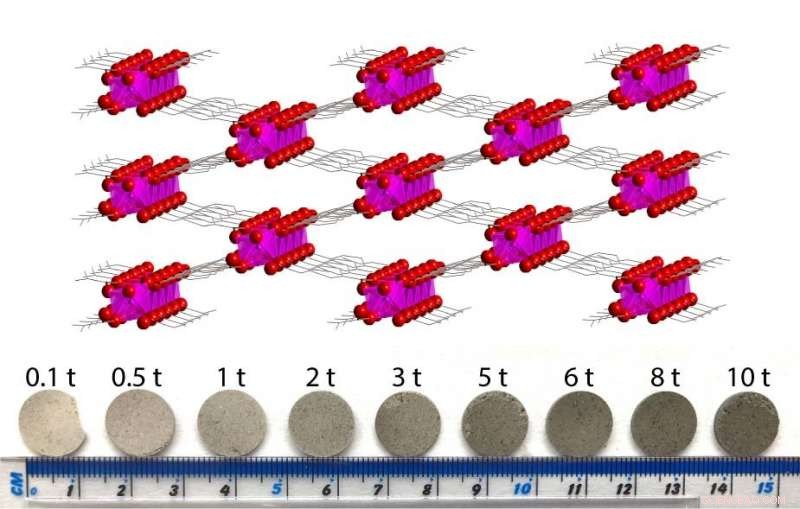
The team led by Professor Jin-Chong Tan from the Department of Engineering Science at Oxford has published a pair of papers in The Journal of Physical Chemical Letters (JPCL), reporting the full characterisation of topical exemplars of MOF dielectrics. Developed in collaboration with the MIRIAM beamline (B22) team led by Dr Gianfelice Cinque at Diamond, this new implementation of the specular reflectance method in the IR and THz offers straightforward access to measure the complex dielectric functions of polycrystalline MOF samples (Figure 2). These papers show the determination of IR and THz frequency-dependent dielectric response of representative MOF compounds, yielding systematic broadband data, bridging the micron (near-IR) to the millimetre (THz) wavelength regimes. Significantly, this has accomplished three orders of magnitude in terms of energy levels, encompassing the eV and meV ranges. Furthermore, the broadband data were used to establish the structure-dielectric property relations as a function of the framework porosity, and, to study the underlying structural evolution subject to a pressure stimulus.
Diamond Light Source
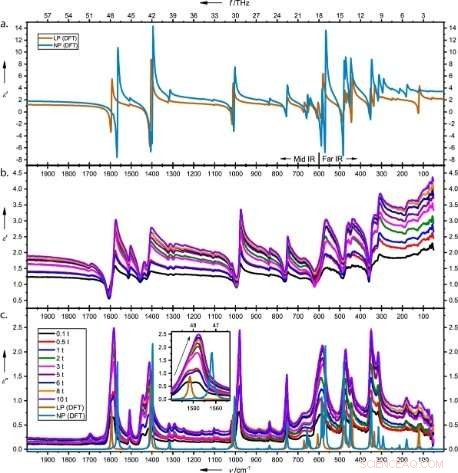
Figure 2: (a) Theoretical spectra predicted from the ab initio density functional theory (DFT). Experimentally obtained (b) real and (c) imaginary components of the complex dielectric functions of MIL-53(Al) structures, between the large pore (LP) and narrow pore (NP) configurations. Pelletising pressures were varied from 0.1 to 10 tonnes. Note the excellent agreement between the DFT and experimental measurements of the real part of the dielectric functions. Credit: ACS