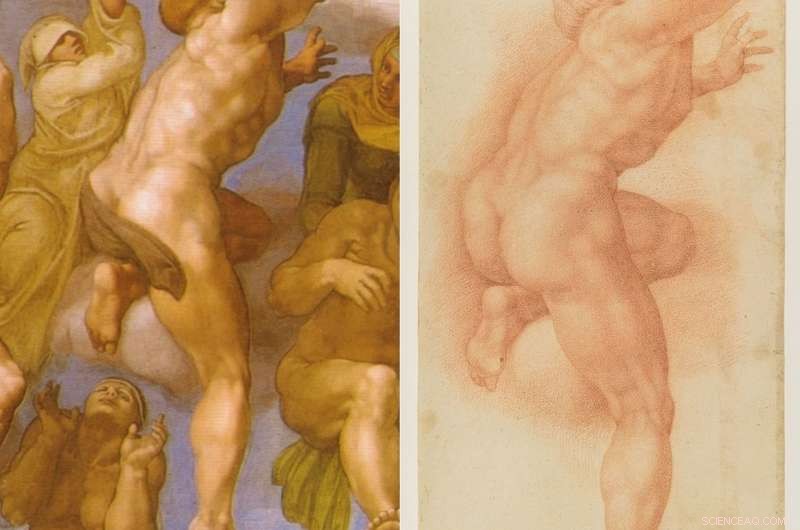
(Left) Detail from "Ascesa dei Beati" (Michelangelo Buonarroti) from Sistine Chapel; (Right) 16th-century drawing reproducing the same detail. An inscription "di mano di Michelangelo" (from Michelangelo's hand), on the bottom-left side of the drawing, was hidden by a tape and revealed after restoration. Credit: PNAS
A team of researchers from the University of Florence, Consorzio Interuniversitario per lo Sviluppo dei Sistemi a Grande Interfase and Paper Conservator has developed a new type of hydrogel for safely removing pressure tape from paper. In their paper published in Proceedings of the National Academy of Sciences, the group describes developing the gel and using it to remove a stretch of tape from a centuries-old paper drawing.
As the researchers note, in the interest of preserving paper-based forms of art, preservationists in the past used tape to repair torn pieces. But in the interest of restoring old pieces of art to their original state, conservators have taken to removing tape and other bindings to reveal anything hidden beneath them. In this new effort, the researchers were confronted with a length of tape that had been applied to the bottom of a piece of paper upon which someone had drawn a picture. The picture was a reproduction of a scene from Michelangelo's Sistine Chapel. The drawing was dated to near the time of the famous painter. The paper had come into the possession of a collector who wanted to have the strip of tape at the bottom removed. The tape, it was noted, was modern.
To remove the tape, the researchers turned to hydrogels, as they have recently been found to be useful in other art restoration efforts. To make their gel, the team started with a clear gel and added solvent molecules which were suspended in a matrix as the gel hardened to a rubbery form. The result was a sheet of hydrogel that could be cut to size. The team cut one such sheet to just cover the tape at the bottom of the page holding the drawing—they let it sit for a while as the gel dissolved the adhesive material in the tape. They then were able to peel off the tape with ease.
After removing the tape, the team discovered that it had concealed a simple hand-written statement, "di mano di Michelangelo" which translates to "from Michelangelo's hand." The researchers do not believe the statement was true, which was why someone had concealed it with the strip of tape. They do plan to conduct more research, however, to learn more about the history of drawing.
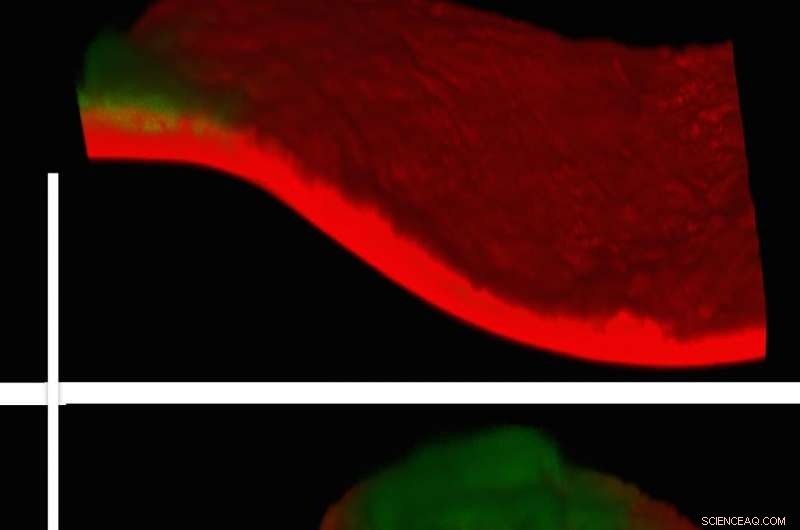
Confocal microscopy 3D images of adhesive tape with paper backing; the adhesive layer of the tape is in red, while the paper backing is invisible; a gel filled with the nanostructured fluid (green) is placed on top of the tape, and the fluid penetrates and fills the paper backing pores. Credit: PNAS
© 2018 Phys.org