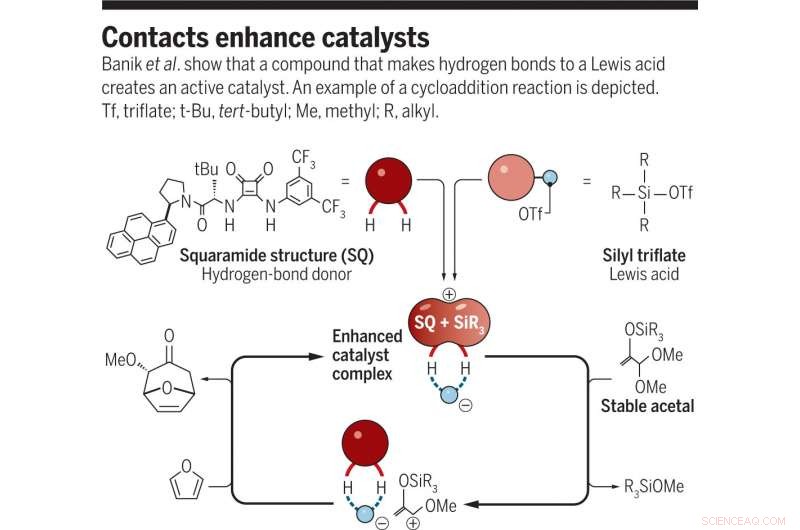
Banik et al. show that a compound that makes hydrogen bonds to a Lewis acid creates an active catalyst. An example of a cycloaddition reaction is depicted. Tf, triflate; t-Bu, tert-butyl; Me, methyl; R, alkyl. Credit: (c) 2017 A. Kitterman/Science
(Phys.org)—A team of researchers at Harvard University has developed a catalytic technique that allows for selecting a single enantiomer (mirror-image isomers) when choosing between one of two mirrored possibilities. In their paper published in the journal Science, the group describes their technique and the possible ways it might be used. Anita Mattson with Worcester Polytechnic Institute offers a Perspective piece on the work done by the team in the same journal issue along with a discussion of why such work is important.
As Mattson notes, using a catalyst to synthesize desired molecules has become a vital part of modern manufacturing processes—approximately 90 percent of all such reactions rely on a catalyst, she says. As she also notes, catalytic methods for creating chiral molecules in the form of mirror image isomers has also become very important in applications such as making pharmaceutical drugs or chemicals for use in agriculture. But, as she further notes, quite often, only one of the resultant molecules from the pair is desired (because they are not normally the same, biologically speaking)—thus, researchers require a means for selecting only the one that is needed. In this new effort, the team at Harvard has developed such a technique.
In their approach, the team used molecular catalysts that had two closely set nitrogen-hydrogen groups as a sort of miniature tweezers, latching (by activating a carbon middle) onto a leaving group (using double hydrogen bonding) to pluck them away, leaving behind undesired material. The result was an ion pair that was biased to favor the one that was desired based on the shape of the catalyst. The group reports that they used their technique to set off a Lewis acid co-catalyst that pulled a leaving group off silicon rather than carbon. They suggest their technique is better for setting off reactions that involve weaker leaving groups on carbon. Mattson suggests that the new technique could be used by other researchers to help in the discovery of new catalyst combinations, perhaps leading to new complex molecular products.
© 2017 Phys.org