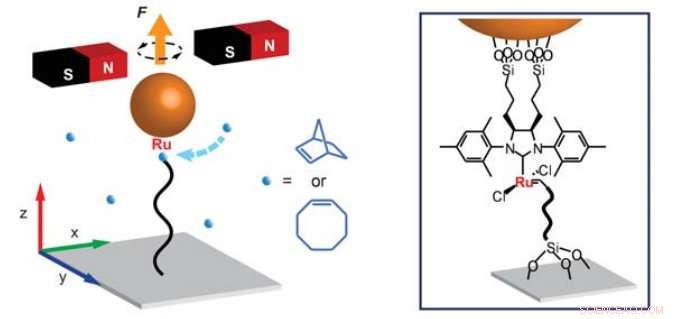
Schematic of magnetic tweezers measurement of a growing polymer tethered between a coverslip and a magnetic particle. Monomers (blue spheres) are incorporated by the Ru-based catalyst. (Right) Linkage chemistry. Credit: Science (2017). DOI: 10.1126/science.aan6837
(Phys.org)—A team of researchers at Cornell University has devised a means for watching as a polymer chain grows after application of a catalyst. In their paper published in the journal Science, the team explains how they achieved this feat and the surprise they found when watching the chains grow in real time.
Chemists know that polymers grow in chains when a catalyst is applied, and most have visualized it, the researchers note, as wormlike, growing steadily from a short worm into one that is longer. But now, that visualization will have to be modified as the team at Cornel has for the first time found a way to view the growth of such chains in real time and in so doing have discovered something new.
To watch a chain grow, the researchers affixed one end of an initial chain to a glass plate. The other end was attached to a magnetic particle which, in turn, was bound to a ruthenium catalyst. As the catalyst was applied, the researchers watched via optical microscopy and other spectroscopic tools—and applied a tiny pair of tweezers. As the chain grew, the researchers yanked on it by pulling the tweezers to stretch the chain to its new full length. In so doing, the researchers were actually able to see it grow. But as it did so, the researchers discovered that the process was not continuous or smooth. Instead, the catalyst caused the formation of a bit of balled-up chain material. The researchers describe it as looking like a hairball coughed up by a cat. The ball would form and then suddenly give way, allowing the chain to stretch to its full length. At that point, a new ball would begin to form. The process repeated as the chain grew, causing the polymer to grow in a wait-and-jump fashion.
The researchers do not yet know why polymers form initially into balls but will continue their research to find out. Understanding exactly how polymers grow, they note, will help to better understand catalytic activity, rates of growth and other polymer properties. It could also be helpful, they note, in better understating biologic processes that involve cell growth, such as protein strands and nucleic acids.
© 2017 Phys.org