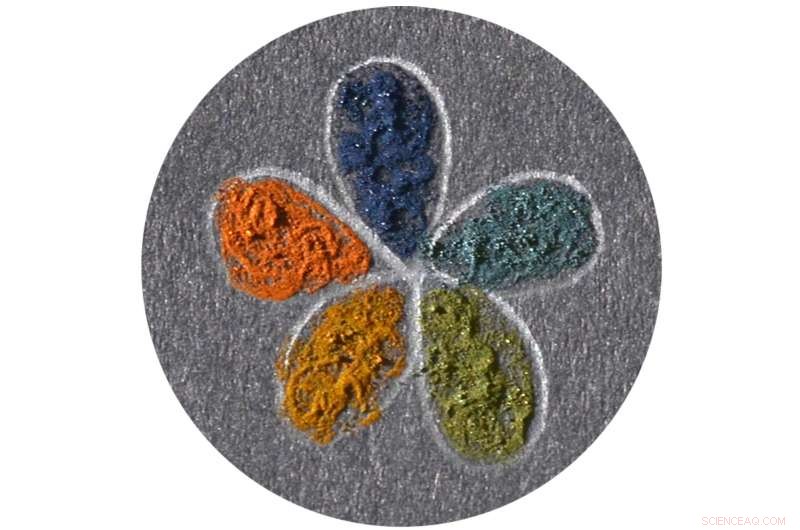
A photo of a rainbow-like flowers, painted with supraball inks made of five different sizes of core-shell synthetic melanin nanoparticles. Credit: Ming Xiao, University of Akron
An international team of researchers has created a new way to color manufactured materials. In their paper published in the journal Science Advances, the group describes how they created the new coloring technique and why they believe it provides benefits over conventional methods.
Prior research has shown that there are two basic ways to produce color in a material. One is to use materials that have molecules capable of absorbing light, the other is to use materials that cause light to scatter in desired ways using nanostructures. Material scientists have found that using structures to create color has many advantages over those that require absorption, but making them that way has proven to be challenging. In this new effort, the researchers report that they have developed a technique that overcomes those challenges, allowing for the production of colored materials in a way that is fast, simple and scalable.
The new technique was inspired by duck and turkey feathers. The team created tiny balls of melanin and then coated them with silica to create structures similar to those found in the bird feathers. Prior research has shown that the spacing between balls of melanin produces different colors. The clear silica coating serves that purpose by forcing the balls farther apart or closer together. The distance is determined by the thickness of the coating—a thick one forces the balls farther apart, while the opposite brings them closer together. Interestingly, observed under a microscope, they are all black. It is only when they are seen from a normal distance that the color emerges. The team notes that changing the size of the balls has no impact on the color produced.
The team calls the result of their effort "supraballs." After creating them and seeing how they worked, they studied them further to understand what was happening. They found that the cores were highly refractive while the shells had a low refractive index, which served to increase reflectance, resulting in colors that were brighter. They note that supraballs could be added directly to paint or plastic base materials to create desired colors and suggest they might also be useful for inks and cosmetic products.
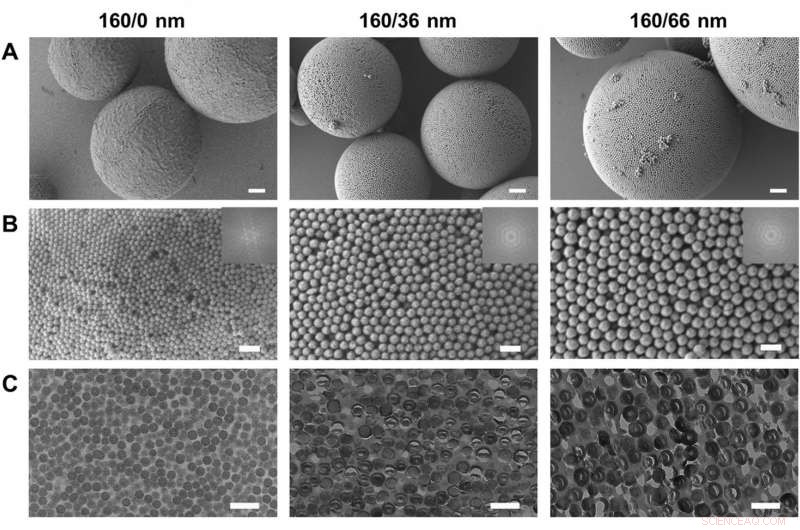
Each column represents supraballs made of different sizes of core-shell synthetic melanin nanoparticles. (A) Scanning electron microscope (SEM) images of whole supraball morphologies. (B) High resolution SEM images of top surfaces of supraballs. (C) Cross-sectional transmission electron microscope images of the inner structure of supraballs. Scale bars, (A) 2 micrometers, (B) 500 nanometers and (C) 500 nanometers. Credit: Xiao et al., Sci. Adv. 2017;3: e1701151
2017 Phys.org