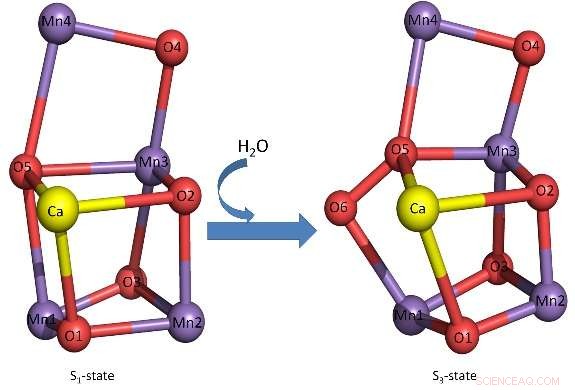
Figure 1: Structural changes of the Mn4CaO5-cluster induced by two flashes of illumination. S1-state: without illumination; S3-state: after two flashes of illumination. Credit: Okayama University
Photosystem II (PSII) is a huge membrane-protein complex that catalyzes light-induced water-splitting, leading to the generation of protons and molecular oxygen. This reaction converts light-energy from the sun into chemical energy that is required to sustain almost all living activities on Earth. The water-splitting reaction is catalyzed by a Mn4CaO5-cluster embedded within the protein matrix of PSII, and proceeds through five intermediate states called Si-states. The structures of PSII and the Mn4CaO5-cluster have been resolved with atomic resolution, however, mechanisms governing water-splitting are unclear due to the lack of intermediate structures of the enzyme.
Now, Michihiro Suga, Fusamichi Akita, Jian-Ren Shen at Okayama University, and colleagues at institutes including Kyoto University, RIKEN, have clarified and resolved the structure of the Mn4CaO5-cluster at S3-state—an intermediate state that exists immediately before the formation of molecular oxygen, generated by two flashes of optical illumination. They employed a pump-probe method where two laser flashes were used to pump the enzyme to the intermediate state, and the X-ray diffraction data were collected by a serial-femtosecond crystallography method using femtosecond X-ray free electron lasers (XFEL) at SACLA, Japan.
The results showed the insertion of a new oxygen atom (water molecule) close to an already existing oxo-oxygen termed O5, enabling the formation of molecular oxygen between O5 and the newly inserted oxygen atom (O6). This clearly demonstrated the mechanism governing the water-splitting reaction catalyzed by PSII, and provided a blueprint for design and synthesis of efficient artificial catalysts that in the future could be utilized in artificial photosynthesis to produce clean and renewable energy from the sun.