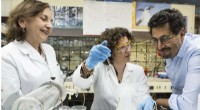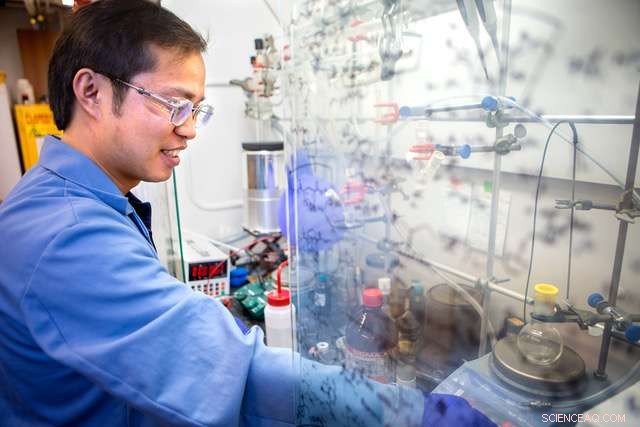
Postdoc Niankai Fu, the lead author of the Science paper. Credit: Cornell University
Give your medicine a jolt. By using - electrochemistry - a technique that combines electricity and chemistry, future pharmaceuticals - including many of the top prescribed medications in the United States - soon may be easily scaled up to be manufactured in a more sustainable way.
Currently, making pharmaceuticals involves creating complex organic molecules that require several chemical steps and intense energy. The process also spawns copious amounts of environmentally harmful - and usually toxic - waste.
At the heart of many popular pharmaceuticals are vicinal diamines, which contain carbon-nitrogen chemical bonds, a bioactive foundation for the medicine. According to Song Lin, assistant professor of chemistry, many widely consumed therapeutic agents have these diamines, including prescription-strength flu medicines, penicillin and some anti-cancer drugs.
Lin and his team have developed a technique that creates vicinal diamines more easily and without the toxic waste. The process uses electricity and chemistry - electrochemistry - and then employs Earth-abundant manganese.
"The current process generates a lot of waste product to make this chemical bond. When you can create a product electrosynthetically, rather than chemically, it is much more straightforward and sustainable," Lin said.
The study is published in journal Science today.
In addition to Lin as a senior author, "Metal-catalyzed Electrochemical Diazidation of Alkenes" was written by lead author postdoctoral researcher Niankai Fu, graduate student Greg Sauer; Ambarneil Saha and Aaron Loo. Cornell laboratory startup money funded this research, and the National Science Foundation provides funding to Sauer.