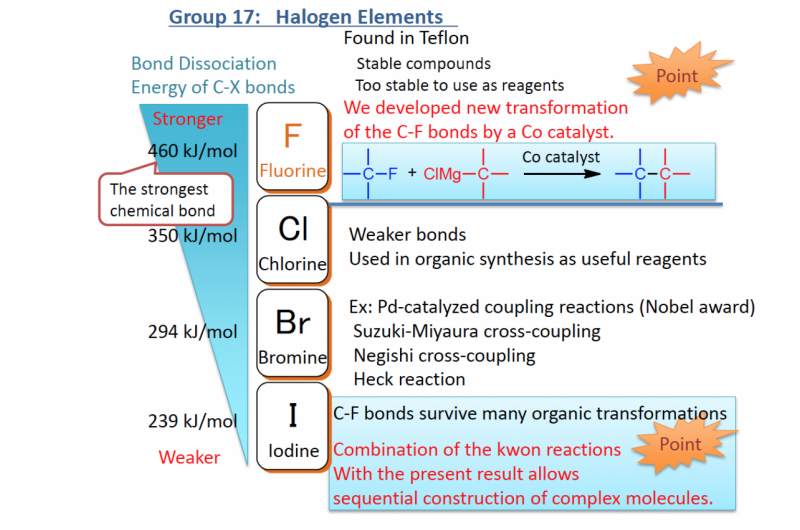
An outline of this research. Credit: Osaka University
Making complicated organic molecules is like solving a Rubik's cube. Organic chemists need to design sequences of reactions to carefully build up parts of a molecule, while maintaining the structure at other sites. Although chemists have developed many ingenious ways of performing chemical transformations, some chemical reactions remain out of reach.
At Osaka University, a team of organic chemists has now developed and enhanced a chemical reaction that allows controlled transformations of one of the toughest chemical bonds. "We previously developed a cobalt-catalyzed Grignard reaction for making hindered quaternary carbon centers. But that reaction also showed potential for modifying carbon-fluorine bonds. We tried many different additives and eventually found one that let us selectively build the same quaternary carbon-carbon bonds at carbon-fluorine sites," says first author Takanori Iwasaki.
The Grignard reaction is a classic reaction in organic chemistry, useful for building the carbon skeleton of molecules by transforming carbon-halogen bonds into carbon-carbon bonds. Fluorine is also considered to be a halogen but the carbon-fluorine bond is among the strongest known and is usually unreactive to Grignard chemistry. Performing any kind of chemical reaction at carbon-fluorine bonds is difficult without affecting the rest of the molecule.
The Osaka team enhanced their catalytic system for performing difficult Grignard chemistry at very crowded, so-called quaternary carbon atoms. By adding a carefully selected additive to this catalytic system, they boosted its ability to work selectively on carbon-fluorine bonds.
"We have shown that this reaction is a very useful tool for sequentially changing parts of a molecule with great control," says group leader Nobuaki Kambe. "Our control over the chemistry of carbon-fluorine bonds should enable much more synthetic freedom for building complex carbon structures."
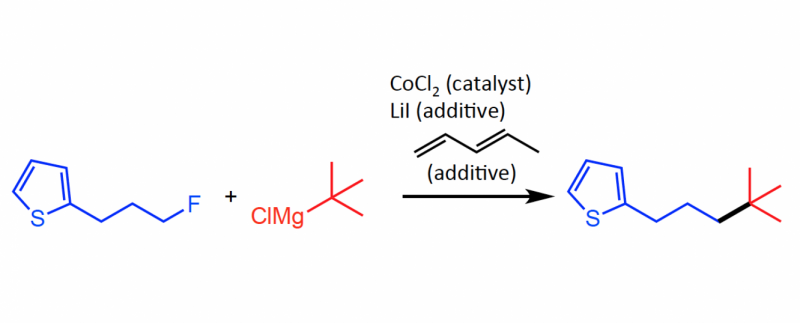
Co-catalyzed cross-coupling of alkyl fluorides with alkyl Grignard reagents. Credit: Osaka University
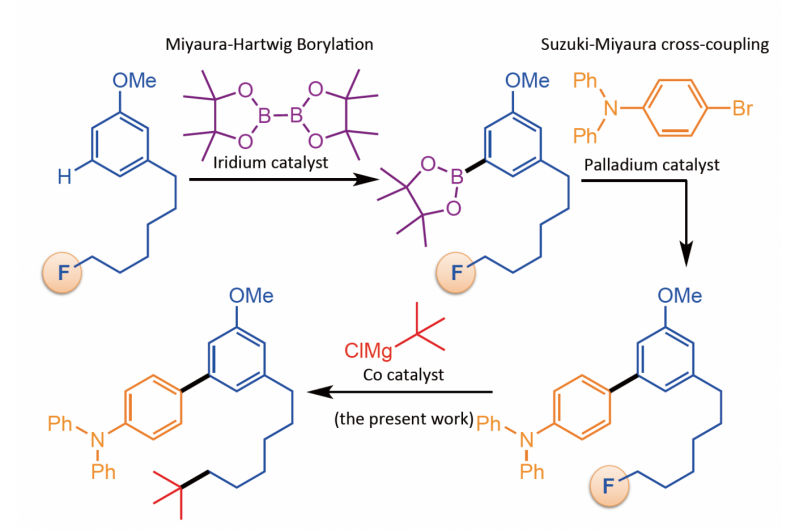
An iterative coupling reaction using the present catalytic system. Credit: Osaka University