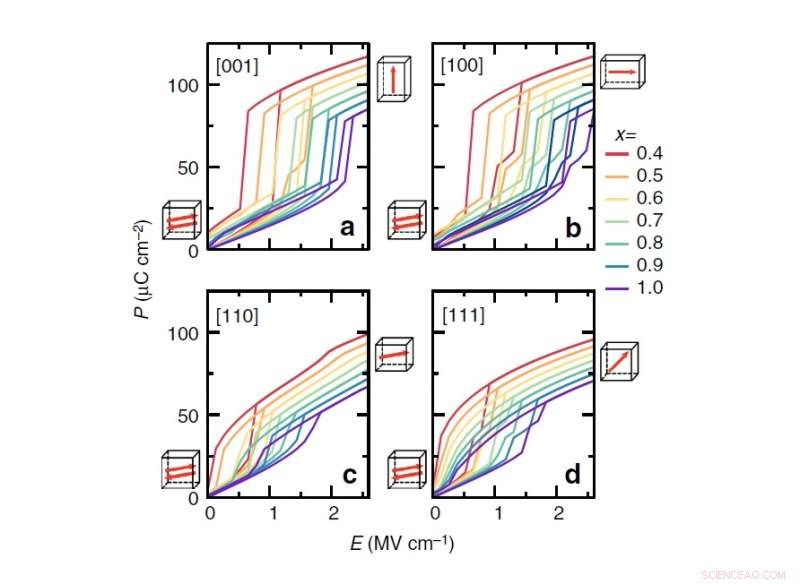
Hysteresis curves showing the electrical properties of antiferroelectric materials. Different colors represent different rare earth element compositions and the four graphs represent different electric field orientations. Credit: Xu et al. Published in Nature Communications
(Phys.org)—One of the greatest challenges in generating energy from renewable sources is finding a way to store the continuously fluctuating energy being produced. Batteries, supercapacitors, and most other energy-storage technologies typically can't respond quickly enough to the second-by-second fluctuations inherent in wind and solar energy sources. One device that does have a sufficiently fast response is electrostatic capacitors, but their drawback is their low energy density—they simply cannot store very much energy in a given volume.
Addressing this problem, researchers in a new study have shown in simulations that antiferroelectric materials based on bismuth can potentially exhibit very high energy densities (150 J/cm3), making them a promising candidate material for electrostatic capacitors. The results point to the possibility of a high-performance, environmentally friendly energy-storage device for renewable energy sources.
The researchers, Bin Xu and Laurent Bellaiche at the University of Arkansas, and Jorge Íñiguez at the Luxembourg Institute of Science and Technology, have published a paper on their investigation of antiferroelectrics for energy storage in a recent issue of Nature Communications.
"We predict that rare-earth-substituted bismuth ferrite is a very promising system for high-power energy storage due to its high energy densities and good efficiencies, as well as its tuning flexibilities," Xu told Phys.org. "The model we developed connects the storage properties with fundamental energetic properties, which may lead to the discovery of new storage materials based on antiferroelectrics."
The key characteristic of antiferroelectric materials is that their adjacent electric dipoles point in opposite directions, which cancel out and result in a net zero polarization. As a result, the materials become ferroelectric under the application of a sufficiently large electric field. These electric properties can be easily tuned by controlling a variety of parameters.
In the new study, the scientists took advantage of this tunability to increase the energy density and efficiency of a particular lead-free antiferroelectric compound (rare-earth-substituted BiFeO3). By changing the orientation of the electric field and the rare earth composition, the researchers predicted the potential for a very high energy density and high efficiency. They expect that tuning other parameters, such as strain or the addition of other rare-earth dopants, may improve these properties even further.
The simulations also enabled the researchers to develop a model to explain the connection between the energy density and the tunable parameters investigated here. This model should also provide guidance for the development of antiferroelectric-based capacitors in the future. The researchers hope that these theoretical results will motivate efforts to experimentally demonstrate antiferroelectric materials with high energy densities.
"With the model, we are interested in assessing the storage properties of known and hypothetical antiferroelectrics via high-throughput first-principles calculations," Bellaiche said. "The promising candidates will be further examined, in collaboration with experimentalists and other theorists."
© 2017 Phys.org